I'm able to calculate the t stat value but don't know how to use the table to determine if I should reject or fail to reject the null hypothesis. I realize that we need the degrees of freedom as well. Is deg. of freedom just the N value or should I use N-1? What do I do after that?
For example my t stat = -1.5811, N = 10, I have a two sided alternative and the Significance level is 5%. I'm currently using this particular table. From what I gather from other sources, I will be able to deteremine a number from the table and compare it to 0.05. And if the determined number is less than 0.05 I reject the null hypothesis; if it's greater than 0.05 I fail to reject the null hypothesis. Is this correct? Please guide me throught this process.
Edit: I have the solution for this example by the way. The magic number determined is 0.1247 I believe and we fail to reject the null hypothesis. I just need someone to walk me through the process.

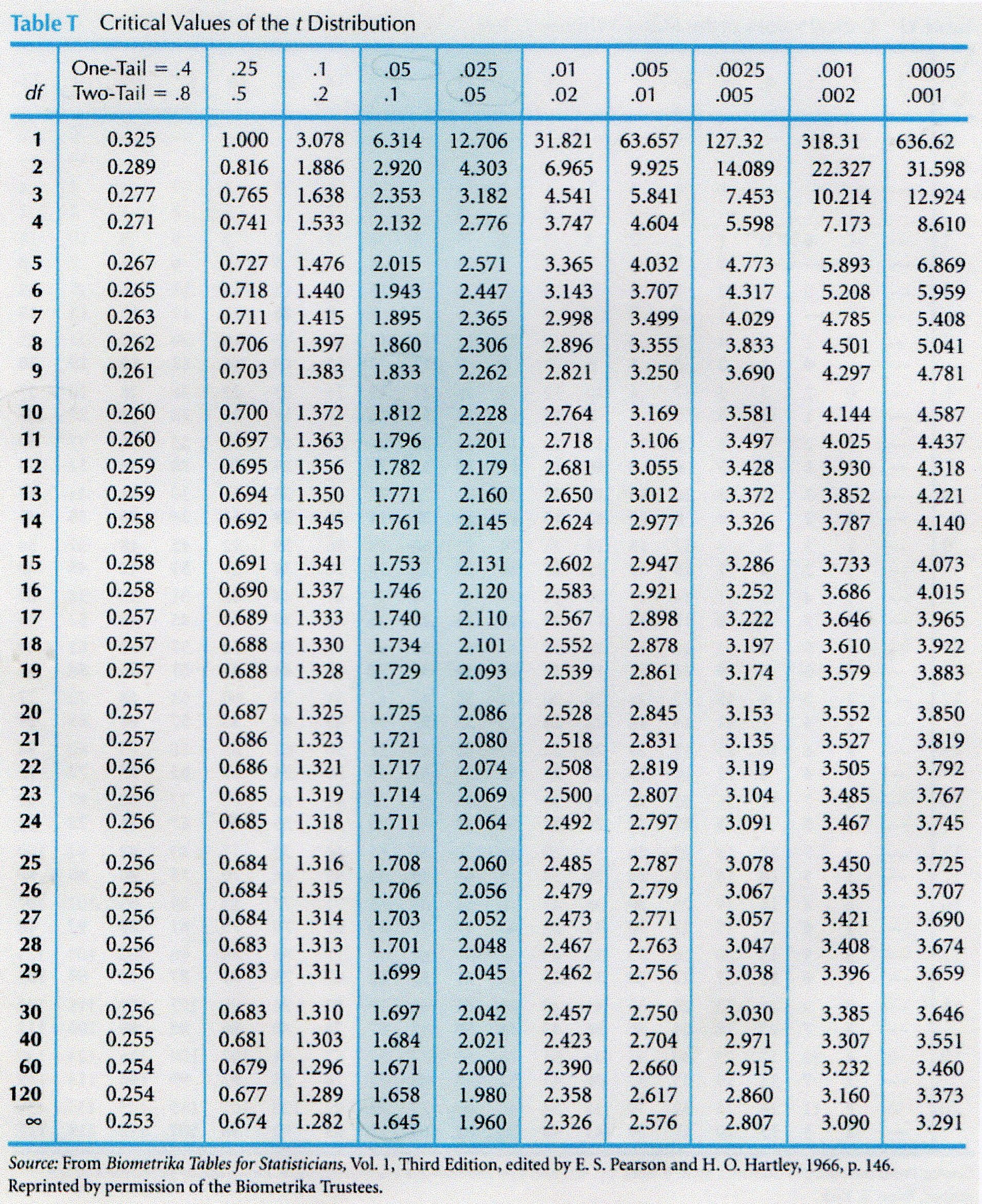
As you can find on Wikipedia https://en.wikipedia.org/wiki/Student%27s_t-test even if we only know that $X \simeq N(\mu, \sigma)$ with uknown parameters, we have $$ \frac{\sqrt{N}(\bar X-μ)}{s} \simeq T_{N-1}.$$ We have $-\frac 1 2 \sqrt{N}$, how likely it comes from a $T_{N-1}$ distribution? Remember it is similar to a normal distribution graphically, so you can accept this value if it is central, and refuse it if it is in the tails. Remember also it is simmetric, so cheching for $\frac 1 2 \sqrt{N}$ is the same.
For $N=10$ we have $t= -1.58$. According to your table, we must refuse this value if it is in the tails of $T_{9}$, i.e. if it is greater than $2.262$, or smaller than $-2.262$. Since $|t| = 1.58 < 2.262$ we cannot reject $H_0$. In other words $-1.58$ is not an uncommon value for a $T_9$ distribution.
For $N=1000$ we have $t=-15.8$. According to the table for large values of $N$, we take $\infty$, so we reject $H_0$ if our value is greater than $1.96$ or smaller than $-1.96$. Since $t=-15.8<-1.96$ we definitely refuse $H_0$ in favor of $H_1$. Note that $T_{999}$ and in general $T$ with large degree of freedom (df) is similar to the standard normal, sharing the value $1.96$ with it.
This exercise is showing us a lesson: if we only have a sample of $10$ units and we get a sample mean of $70$, we still can believe the average is $80$. If we have $1000$ units and the sample average is still $70$, probably $80$ is not the real mean!