I am trying to evaluate the following Fourier transform $$F(x,n) = \int_{-\infty}^{\infty}\frac{\mathrm{e}^{\mathrm{i}tx}} {(\,t - \mathrm{i}\,)^{n/2}}\,\mathrm{d}t\,,\quad \forall\ x \in \mathbb{R}^{+}\,,\ n\in \mathbb{N}. $$
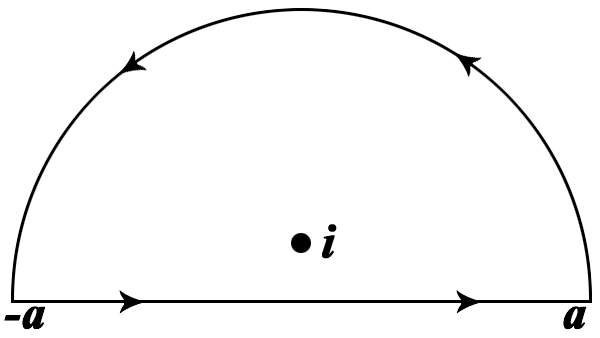
For even $n$, we can use the contour integral on the complex plane $t$ where the contour consists of the interval $\left[-a, a\right]$ on the real axis and a hemisphere on the upper half plane centered at the origin with a radius of $a$ for $a > 0$. We obtain the result using Cauchy's differentiation formula.
For odd natural number $n$, there is a branch cut for $\displaystyle(t - \mathrm{i})^{\frac n 2}$. Now if we make a slit from $t = \mathrm{i}$ and integrate $\displaystyle\frac{e^{\mathrm{i}tx}}{\left(\,t -\mathrm{i}\,\right)^{\frac n 2}}$ starting from $t = \mathrm{i}$ we will have a divergent integral for $n \geq 3$. What could be done ?

We extend the original integral on $\frac n2$ by a complex number $\Re z>0$. $$F(x,z) := \int_{-\infty}^{\infty}\frac{\mathrm{e}^{\mathrm{i}tx}} {\left(t - \mathrm{i}\right)^z}\,\mathrm{d}t\,,\quad \forall\ x \in \mathbb{R}^{+}\,,\ \Re z\in(0,\infty).$$
We have to make the extension to make use of the contour integral because of the subtlety of the convergence condition of the contour integral in different region is different. The convergence set for $z$ is the intersection of all the convergence sets of $z$ on all the different legs. We use analytical continuation to make the connection.
Proof: We show this via Morera's theorem applied to an arbitrary closed simple smooth contour on any arbitrarily given disk $B$ of finite radius in $\Re z\in(0,\infty)$. A continuous function on a compact set is uniformly continuous. So $g(z,t)$ being continuous on the compact set $B\times[0,1]$ is uniformly continuous on $B\times[0,1]$. We can use Riemann sum for the integral to finish the proof.
Proof: We show this via Morera's theorem applied to an arbitrary closed simple smooth contour $C$ on any arbitrarily given disk $B$ of finite radius in $\Re z\in(0,\infty)$.
By Lemma 1, $F(x,z,R):=\int_{-R}^R f(t,x,z)\,\mathrm dt$, where $f(t,x,z):=\frac{\mathrm{e}^{\mathrm{i}tx}} {\left(t - \mathrm{i}\right)^z}$, is holomorphic in $\Re z\in(0,\infty)$. We will show below that for any fixed $x\in\mathbb R^+$, $F(x,z,R)$ uniformly approaches $F(x,z)$ with respect to $B$ as $R\rightarrow\infty$. Then $$0=\lim_{R\rightarrow\infty}\oint_C F(x,z,R)\,\mathrm dz = \oint_C \lim_{R\rightarrow\infty}F(x,z,R)\,\mathrm dz=\oint_C F(x,z)\,\mathrm dz$$ by Morera's theorem, the conclusion of the Lemma follows.
To that end, let $$\overline F_+(x,z,R):=\int_R^\infty\frac{\mathrm{e}^{\mathrm{i}tx}} {\left(t - \mathrm{i}\right)^z}\,\mathrm dt = \frac1{\mathrm ix}\bigg(-\frac{\mathrm{e}^{\mathrm{i}Rx}} {\left(R - \mathrm{i}\right)^z}+z\int_R^\infty\frac{\mathrm{e}^{\mathrm{i}tx}} {\left(t - \mathrm{i}\right)^{1+z}}\,\mathrm dt\bigg)$$ and $$\overline F_-(x,z,R):=\int_R^\infty\frac{\mathrm{e}^{-\mathrm{i}tx}} {\left(-(t+\mathrm{i})\right)^z}\,\mathrm dt = \frac1{\mathrm ix}\bigg(\frac{\mathrm{e}^{-\mathrm{i}Rx}} {\left(-(R - \mathrm{i})\right)^z}+z\int_R^\infty\frac{\mathrm{e}^{-\mathrm{i}tx}} {\left(-(t - \mathrm{i})\right)^{1+z}}\,\mathrm dt\bigg)$$
Note: The integration by parts is needed because we need to make use of the oscillatory behavior of the harmonic function without which the integral diverges for $\Re z\in (0,1]$.
For $z=u+\mathrm iv$, $u,v \in\mathbb R$, $|(t-i)^z|=(t^2+1)^ue^{-\alpha v}$, where $\alpha=\arg(t-i)$ so $|\alpha|<\pi$. As $z$ is in a finite radius disk, $|u|,|v|\in [a,b]$ for some constant real numbers $0<a<b$. $|(t-i)^z|>t^ae^{-\pi b}>0$, $|z|<\sqrt{a^2+b^2}$.
$$|\overline F_+(x,z,R)|<\frac 1x \bigg(\frac1{R^ae^{-\pi b}}+\sqrt{a^2+b^2}\int_R^\infty \frac1{t^{1+a}e^{-\pi b}}\,\mathrm dt\bigg)=e^{\pi b}\bigg(1+\frac{\sqrt{a^2+b^2}}a\bigg)\frac1{xR^a}.$$ $|\overline F_+(x,z,R)|\rightarrow 0$ as $R\rightarrow\infty$ uniformly with respect to $z\in B$. The same goes for $|\overline F_-(x,z,R)|$. So $F(x,z,R)\rightarrow F(x,z)$ as $R\rightarrow\infty$ uniformly with respect to $z\in B$ for fixed $x\in\mathbb R^+$.
QED
Now we proceed to evaluate the original integral.
Make the branch cut of $u^z$ in the variable $u$ along the imaginary axis. We construct a contour extending the real axis segment around the upper semicircle, with a slit cut along the imaginary axis with a keyhole around $i$. $$I_1(R)+I_2(R)+I_3(r,R)+I_4(r)+I_5(r,R)+I_6(R)=0,$$ where \begin{align} I_1(R) &= \int_{-R}^R\frac{\mathrm{e}^{\mathrm{i}tx}} {\left(\,t - \mathrm{i}\,\right)^z}\,\mathrm{d}t \\ I_2(R) &= \int_0^{\frac\pi2}\frac{\mathrm{e}^{\mathrm{i}xRe^{\mathrm i\theta}}} {\left(\,Re^{\mathrm i\theta} - \mathrm{i}\,\right)^z}iRe^{\mathrm i\theta}\,\mathrm{d}\theta \\ I_6(R) &= \int_{\frac\pi2}^\pi\frac{\mathrm{e}^{\mathrm{i}xRe^{\mathrm i\theta}}} {\left(\,Re^{\mathrm i\theta} - \mathrm{i}\,\right)^z}iRe^{\mathrm i\theta}\,\mathrm{d}\theta \\ I_4(r,R) &= e^{-x}\int_{\frac\pi2}^{-\frac32\pi}\frac{\mathrm{e}^{\mathrm{i}xre^{\mathrm i\theta}}} {\left(re^{\mathrm i\theta}\right)^z}ire^{\mathrm i\theta}\,\mathrm{d}\theta = ie^{-x}\int_{\frac\pi2}^{-\frac32\pi}e^{ixre^{i\theta}}(re^{i\theta})^{1-z}\,\mathrm d\theta \\ I_3(r,R) &= e^{-x}\int_R^r\frac{\mathrm{e}^{\mathrm{i}xte^{\mathrm i\frac\pi 2}}} {\big(te^{\mathrm i\frac\pi 2}\big)^z}e^{\mathrm i\frac\pi 2}\,\mathrm dt = -ie^{-x-i\frac\pi 2z}\int_r^R\frac{e^{-xt}}{t^z}\,\mathrm dt \\ I_5(r,R) &= e^{-x}\int_r^R\frac{\mathrm{e}^{\mathrm{i}xte^{-\mathrm i\frac32\pi}}} {\big(te^{-\mathrm i\frac32\pi}\big)^z}e^{-\mathrm i\frac32\pi}\,\mathrm dt = ie^{-x+i\frac32\pi z}\int_r^R\frac{e^{-xt}}{t^z}\,\mathrm dt \end{align}
Let $z=u+iv$ for real $u$ and $v$. $|(Re^{i\theta}-i)^z|=\rho^ue^{-\alpha v}$, where $\rho:=|Re^{i\theta}-i|,\,\alpha:=\arg(Re^{i\theta}-i)$. We take the branch cut where $\alpha\in\big(-\frac32\pi,\frac12\pi\big]$
When $u>0$, $\rho>R-1$, $|(Re^{i\theta}-i)^z|>(R-1)^ue^{-\alpha v}$, since $\alpha$ is bounded from both sides, $I_2(R), I_6(R)\rightarrow 0$ as $R\rightarrow\infty$. When $u\in(0,1)$, $|(re^{i\theta})^{1-z}|=r^{1-u}e^{-\theta v}$, then $I_4(r)\rightarrow 0$ as $r\rightarrow 0^+$. $I_3(r,R)$ and $I_5(r,R)$ converge as $r\rightarrow 0,\, R\rightarrow\infty$ iff $u\in(0,1)$. For $u\in(0,1)$, \begin{align} I_3(0,\infty)+I_5(0,\infty) &= -2e^{-x+i\frac\pi2z}\sin(\pi z)\int_0^\infty \frac{e^{-xt}}{t^z}\,\mathrm dt \\ &= -2e^{-x+i\frac\pi2z}\sin(\pi z)x^{z-1}\int_0^\infty \frac{e^{-t}}{t^z}\,\mathrm dt \\ &= -2e^{-x+i\frac\pi2z}x^{z-1}\sin(\pi z)\Gamma(1-z) \\ &= -2e^{-x+i\frac\pi2z}x^{z-1}\frac\pi{\Gamma(z)}. \end{align} The equating of the last integral expression with the gamma function is valid only for $u\in(0,1)$. Taking the intersection which is $u\in(0,1)$ of all the convergence sets of $z$ on all the legs, $$F(x,z) = I_1(\infty) = e^{-x+i\frac\pi2z}x^{z-1}\frac{2\pi}{\Gamma(z)}. \tag1$$ The right hand side of equation (1) is entire with respect to $z$. By Lemma 2, $F(x,z)=I_1(\infty)$ can be analytically continued from $\Re z\in(0,1)$ to $\Re z\in(0,\infty)$. Therefore Equation $(1)$ can be extended to the open upper plane of the complex plane $\Re z\in(0,\infty)$ for positive $x\in\mathbb R^+.$