Is there some fractal like the koch snowflake, but only with many circles around a bigger initial circle, each of them surrounded by smaller circles and so on (but all of them kissing one bigger circle)? So circles instead of the triangles in a koch snowflake... If not, why?
2026-03-30 00:16:56.1774829816
 On
On
Is there a koch circle?
2k Views Asked by Bumbble Comm https://math.techqa.club/user/bumbble-comm/detail At
3
There are 3 best solutions below
4
On
Parts of the Mandelbrot set look like circles with smaller circles attached recursively:
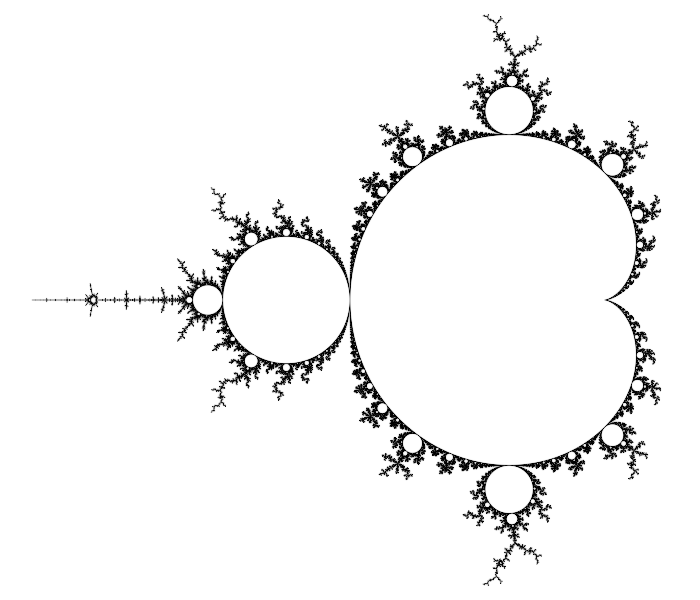
They aren't quite exact circles (except for the one centered at $-1+0i$), but the property that the radius of the smaller circle attached at rational angle $\frac{p}{q}$ measured in turns is approximately $q^2$ times smaller provides a way to construct a similar fractal from exact circles:
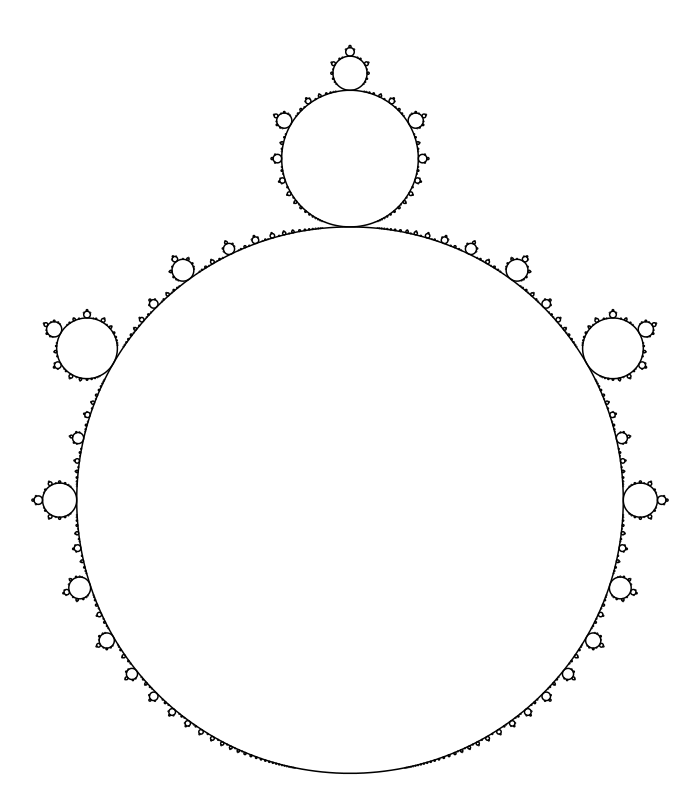
Haskell source code using the Diagrams library:
import Diagrams.Prelude
import Diagrams.Backend.SVG.CmdLine (defaultMain)

main
  = defaultMain
  $ diagram 1
  # rotateBy (-0.25)
  # pad 1.1
  # lw thin
  # bg white

power = 2

minimumRadius = 0.001

diagram radius
  | radius < minimumRadius = mempty
  | otherwise = circle radius <> mconcat
     [ diagram r
     # rotateBy (s - 0.5)
     # translate (r2 (rr * cos t, rr * sin t))
     | den <- [ 2 .. ceiling (sqrt (radius / minimumRadius)) ]
     , num <- [ 1 .. den - 1 ]
     , num `gcd` den == 1
     , let s = fi num / fi den
     , let t = 2 * pi * s
     , let r = radius / fi den ** power
     , let rr = radius + r
     ]
  where
    fi = fromInteger
Reducing the power makes the circles larger, but too low and they eventually overlap - in any case the power must be larger than one to ensure the circles actually do get smaller.
 Here plotted by Ken Monks
Is this any good?
It's the last frame in the animation for this answer.