I'm working on something where it is important that some points are "uniformly distributed" over the unit square. Here's a somewhat simplified version of what I'm working with:
Let's say that for each natural number $n$ we have a set of points in the unit square, which we'll call $S_n$. I want to have a criterion that will tell me if the points in $S_n$ become more and more uniformly distributed over the unit square as $n \to \infty$. I did come up with a definition that is good enough for my purposes:
Given a rectangle of nonzero area $A$ contained within the unit square, let $k_n$ be the number of points in $S_n$ which are inside the rectangle. We can say that our sets have uniformly distributed points if $$ \lim_{n \to \infty} \frac {k_n}{|S_n|} = A $$ for all possible rectangles.
For example, if $S_n$ is an $n \times n$ grid of points evenly spread across the unit square, then the points would be uniformly distributed by this definition, but many other less orderly collections of sets would also satisfy this definition. This works well enough for me, but I don't want to use my own definition if there is some other standard definition. Is there a well-established alternative?
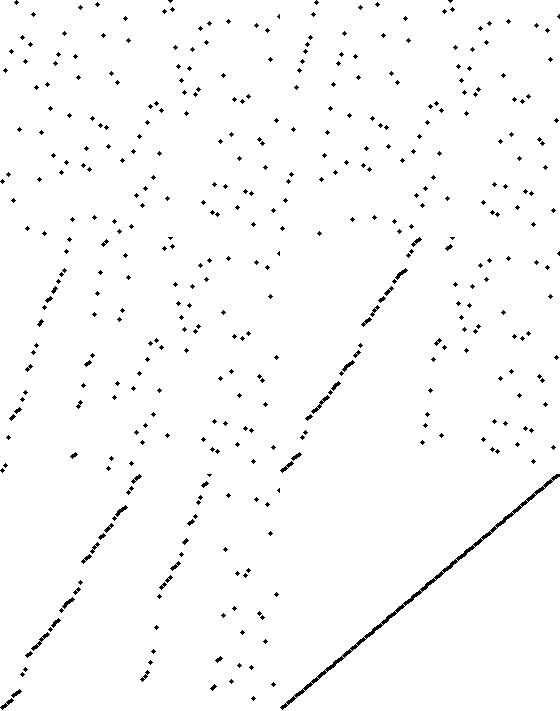
For some context, I'm studying the "shape" of diagrams of sorting algorithms like this. For the algorithm to make the shape, it is important that the points start uniformly distributed, so I need some criteria to check against. My real definition includes probabilities - as the length of the list increases, it must become arbitrarily likely that the number of points in the rectangle divided by the total number of points becomes arbitrarily close to the area of the rectangle. I figured it would be simpler to forget about randomness for this question, but if there is a known definition that already takes randomness into account, that would be ideal.