I am trying to find the following limit
$$\lim_{n \to \infty} \frac{2^{(\log_2 n)^2}} {2^{(\log_2 n)^3}}$$
I really don't know where to start and any help would be appreciated!
I am trying to find the following limit
$$\lim_{n \to \infty} \frac{2^{(\log_2 n)^2}} {2^{(\log_2 n)^3}}$$
I really don't know where to start and any help would be appreciated!
 On
On
We're going to apply two of the Laws of Logs. We will use
\begin{eqnarray*} \log_b(x^y) &=& y\log_b(x) \\ \\ \log_b\!\left(\frac{x}{y}\right) &=& \log_b(x)-\log_b(y) \end{eqnarray*}
I'm going to take the log of your expression:
\begin{eqnarray*} \log_2\left(\frac{2^{(\log_2 n)^2}}{2^{(\log_2 n)^3}}\right) &=& \log_2\left(2^{(\log_2 n)^2}\right) - \log_2\left(2^{(\log_2 n)^3}\right) \\ \\ &=& (\log_2 n)^2\cdot\log_2(2) - (\log_2 n)^3\cdot\log_2(2) \\ \\ &=& (\log_2 n)^2 - (\log_2 n)^3 \\ \\ &=& (\log_2 n)^2 \cdot (1-\log_2n) \end{eqnarray*}
Hopefully, you agree that $\log_2n \to \infty$ as $n \to \infty$. This means that $$\lim_{n \to \infty}(\log_2 n)^2 \cdot (1-\log_2n) = -\infty$$
Going back a few lines, tells us then that $$\lim_{n \to \infty} \log_2\left(\frac{2^{(\log_2 n)^2}}{2^{(\log_2 n)^3}}\right) = -\infty$$
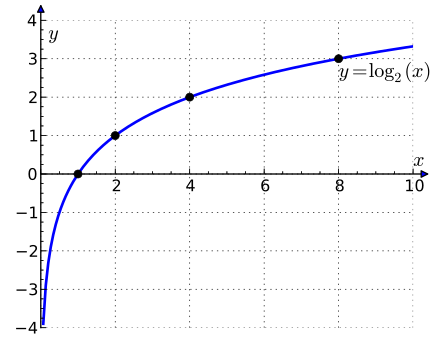
Looking at the graph $y = \log_2 x$ shows us that $\log_2 x \to -\infty$ as $x \to 0$ and hence $$\lim_{n \to \infty} \frac{2^{(\log_2 n)^2}}{2^{(\log_2 n)^3}} = 0$$
On
Hint: $$\frac{2^{\log_2(n)^2}}{2^{\log_2(n)^3}}=2^{\log_2(n)^2-\log_2(n)^3}$$ What is $\lim\limits_{n\to\infty}\left(\log_2(n)^2-\log_2(n)^3\right)$?
Hint
What is the limit of the logarithm of your expression?