You may have heard that recently it was proven that the smallest number of starting clues for a Sudoku game, guaranteeing a unique solution, is 17.
An example is shown below.
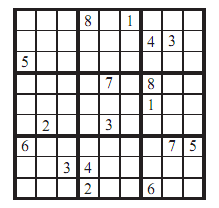
I am interested in the opposite:
What is the largest number of starting clues for a Sudoku game that does not guarantee a unique solution?
I have a lower bound of 63. This is if you take a solved Sudoku and delete every instance of two numbers (i.e., delete all the 1s and 2s). Alternatively, you could delete the top two rows, again yielding two different solutions for 63 starting clues.
Can you do better than 63, or is 63 is the highest?

I conclude that the largest number of starting clues for any Sudoku to be ambiguous is 77 (81 - 4), and you can construct it by finding a 'rectangle' with ones on two opposite corners and twos on the other two opposite corners. Remove all four of them. Now you can solve it in two ways: it is ambiguous.
A random Sudoku from the Internet: