Precalculus Roots of Unity

599 Views Asked by At

Let $A$ be the set of all complex numbers $z$ such that $z^{24}=1$ and let $B$ be the set of all complex numbers $w$ with $w^{54}=1.$ That is \begin{align*} A&=\{z\;|\;z^{24}=1\}\\ B&=\{z\;|\;z^{54}=1\}\\ \end{align*} Finally let $C$ be the set of all numbers that can be formed by multiplying an element of $A$ by an element of $B:$

$C=\{zw\;|\;z\in A,w\in B\}.$

How many distinct elements are there in $C?$

Hi guys, I have been having some trouble with this problem. I have tried using the 24th roots of unity, but has gotten me nowhere so far. Can anyone help me?

3

There are 3 best solutions below

0
On

The $24$th roots of unity are $e^{2\pi i x/24}$ and the $54$th roots are $e^{2\pi iy/54}$, where $x,y$ are integers. So the elements of $C$ are $$e^{2\pi i((x/24)+(y/54))}=e^{2\pi i(9x+4y)/216}\ .$$ So, we need to know how many different residues modulo $216$ are taken by the expression $9x+4y$. The answer is, all of them: since $9$ and $4$ are relatively prime, the equation $$9x+4y=m$$ has a solution for any integer $m$, and so it certainly has a solution for $m=0,1,\ldots,215$.

Thus, the number of elements in $C$ is $216$.

0
On

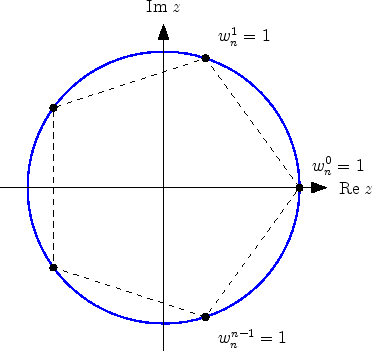
You can think about roots of unity as points evenly spread out on the unit circle, or if you connected the dots, as a polygon pointing right.

If you were considering cube roots of unity, you'd have one point at $1+0i$ and two points spread equally far apart—an equilateral triangle. If you were considering fifth roots of unity, you'd get something like this.

More interestingly, you can multiply roots of unity (this can lead to what's called a cyclic group). If you pick a root—a point on the unit circle; we'll call it $R$—and multiply by another root $S$, you'll end up at yet another root. In fact, you're starting at $R$ and rotating around the origin by the angle between $1$ and $S$. More or less, all we're doing is $$1^{x/54} \times 1^{y/54} = 1^{(x+y)/54}.$$

Knowing that multiplication by a root of unity is a rotation, we can frame the problem in some different ways. One of them might be, "If I have 54 copies of a 24-gon, each one rotated by 1/54th of a circle from the last, how many vertices will overlap? How many distinct point will there be?" Your final answer would be the starting number of vertices, 54 x 24 = 1296, minus the number of duplicates. (Taking this particular approach may not be your best bet; there are a lot!)

Also, check out this nearly identical question on StackExchange: Number of elements in sets of roots of unity

0
On

We are in Z_lcm[24,54]=Z_216and so the number is 216