I am having trouble understanding the product of CW complexes. I know how to actually do the computations and all, I just don't understand how exactly it works.
So here's my questions specifically: If $X,Y$ are CW-complexes then say $e,f$ are $p,q$ cells on $X,Y$ respectively, then we know that $e \times f$ will be a $p+q$ cell in $X \times Y$. But this cell we have to think of as $D^{p+q}$ with some identification on the boundary sphere. But what we have here is $(D^p \times D^q)$. So I guess we need to know that we have homeomorphism of pairs $(D^{p+q},S^{p+q-1}) \cong (D^p \times D^q, S^{p-1} \times D^q \cup D^p \times S^{q-1})$. But that's what I do not get. How exactly do this homeomorphism work?
I kinda see it in the case $p=q=1$ (it's just that a square and a disc are homeomorphic with canonical identifications in the boundaries). But I am having trouble defining it or actually visualizing it in higher dimensions. Any help?
Thanks!

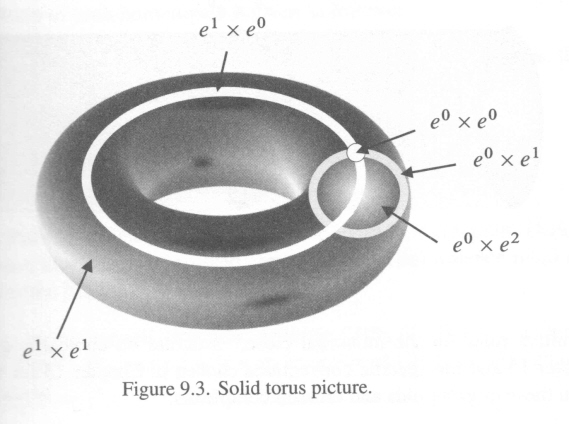
You can think of $D^n$ as the homeomorphic cube $I^n$. This way, the product $$\left(D^k\times D^l,\ \partial D^k× D^l\cup D^k×∂D^l\right)\\ \cong\left(I^k×I^l,\ ∂I^k×I^l\cup I^k×∂I^l\right)\\ =\left(I^{k+l},∂\left(I^k×I^l\right)\right)\\ \cong \left(D^{k+l},∂\left(D^k×D^l\right)\right)$$
The homeomorphism between $D^k\cong I^k$ i given by $$x\mapsto \dfrac{x\cdot||x||_2}{||x||_\infty}$$
The characteristic map is $\Phi_{\alpha,\beta}=Φ_{α}×Φ_β:D^k×D^l\to X×Y$