Attached below is the past examination question. I'll be presenting my thoughts and queries on it.

I initially thought of breaking this entire challenge down into multiple smaller ones.
- Prove any value of $\lambda$ represents a circle through $A(7,2)$ and $B(0,9)$
- Sketch the circle with through points $A$ and $B$, find the midpoint which should then be the center I suppose.
- Since the circle touches the y-axis, the radius would then be the length of the x-coordinate.
Below is a very rough sketch that came to mind:
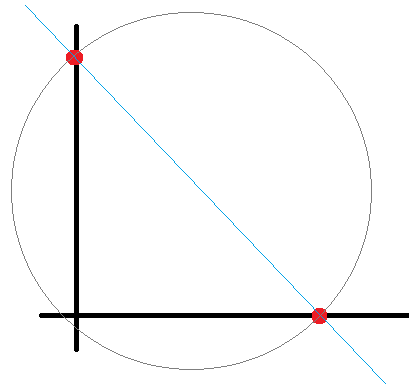
How should I go about tackling this question? How would one prove the initial challenge?

The equation represents a circle because it is quadratic in $x$ and $y$ with equal coefficients for $x^2$ and $y^2$ and no coccurance of $xy$, so that it can easily be transformed in to $$\tag1(x-u)^2+(y-v)^2=r^2$$ (with $u,v,r$ depending on $\lambda$). We don't need to explicitly perform the transformation, we just need to ensure that we won't end up with an imaginary or zero radius. But this is clear as we can verify by plugging in that $(7,2)$ and $(0,9)$ fulfill the equation.
If the circle touches the $y$-axis then clearly $(0,9)$ is the touching point. That implies that the center of the circle is at $y=9$. That is, the $v$ in $(19$ must equal $9$. That is, the llinear term in $y$ in the original equation must be $-18y$. We find that it is $(-11+\lambda)y$, so we need $\lambda=-7$. The equation becomes $$x(x-7)+(y-9)(y-2)-7(x+y-9)=0 $$ or maybe more userfriendly $$ x^2-14x+y^2-18y+81=0$$ or to allow reading off the center and radius: $$ (x-7)^2+(y-9)^2=7^2.$$
To find the other tangent through the origin, we could reflect the point $(0,9)$ at the line through $(0,0)$ and the circle center $(7,9)$. But the reflection is easier with the point $(0,130)=9\cdot(7,9)+7\cdot(-9,7)$ because the reflection transforms it to $9\cdot(7,9)-7\cdot(-9,7)=(126,32)$. Hence the other tangent is the line through $(0,0)$ and $(126,32)$ (or as well through $(63,16)$).