I've been working with Spivak's Differential Geometry exercises and I found myself confused with this one: "Let $C\subset \mathbb{R} \subset \mathbb{R}^2$ be the Cantor set. Show that $\mathbb{R}^2 - C$ is homeomorphic to the surface shown at the top of the next page."
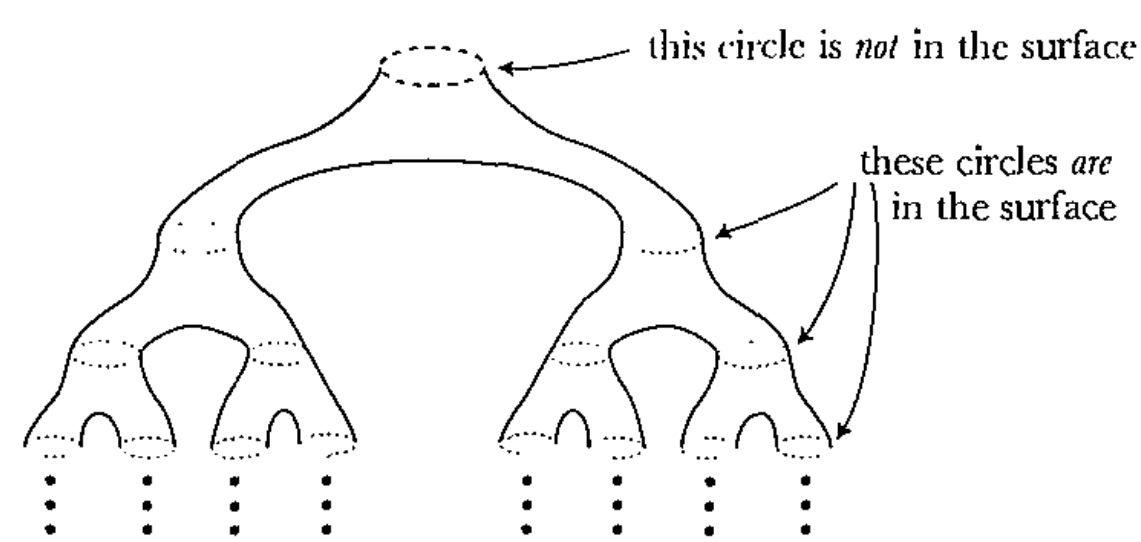
Well, for me it's obviously homeomorphic: if we think of $\mathbb{R}$ inside $\mathbb{R}^2$ as the $x$-axis for instance, the set $\mathbb{R}^2 - C$ will be the plane minus the pieces of $\mathbb{R}$ that makes up Cantor set, so that we'll have in the end the plane with the $x$-axis with a lot of holes like the surface shown above. For me it's kind of intuitive that $\mathbb{R}^2-C$ can be continuously deformed into the surface above, but how do we really come tho prove this fact?
Since Spivak says that the pre-requisites are just his Calculus on Manifolds and basic notions of metric spaces I feel that we wouldn't need any advance topology for this job, but I'm a little confused really.
Can someone give a little advice on how do we solve problems like this?
Thanks very much in advance!


Remember that $C$ is obtained via the "middle thirds process": One takes the decreasing chain of closed sets $[0,1] = C_0 \supset C_1 \supset C_2 \supset \cdots,$ where $C_{n+1}$ is obtained from $C_n$ by removing the remaining "middle third" open intervals, and sets $C = \bigcap_{n=0}^{\infty} C_n$.
Thus $\mathbb R^2 \setminus C$ is equal to the union $\bigcup_{n=1}^{\infty} \mathbb R^2 \setminus C_n$.
Now, $C_n$ is a union of closed intervals. Let $D_n = C_n\times [0,1] \subset \mathbb R^2$. Note that deleting $\mathbb R^2 \setminus C_n$ is homemomorphic to $\mathbb R^2 \setminus D_n$, in way that is compatible with the inclusions as we pass from $n$ to $n+1$. (Exercise! And see below for a little more on this.)
Thus $\mathbb R^2 \setminus C$ is homemomorphic to the union $\mathbb R^2 \setminus D_n$. If you think about this union, you begin with $\mathbb R^2$ minus a closed square, then add in the "middle third" of that square, than the "middle thirds" of the two smaller remaining rectangles, and so on.
This gives you Spivak's picture, in the form described in user75064's answer, and with closed rectangles being removed rather than round disks. A final homeomorphism (intuivitely fairly evident, but a bit harder to write down) converts the rectangles to disks, and gives Spivak's picture.
If you want to think about how to make all of this rigorous, my suggestion is to begin with proving that $\mathbb R^2$ minus a closed interval is homeomorphic to $\mathbb R^2$ minus a closed rectangle.
It is not so hard to prove this by a well-chosen explicit homeomorphism, but not completely trivial either.
The other steps, which involve removing the complements of rectangles by the complements of disks are harder to write down explicitly, but are (in my view) actually less deep than the preceding step, and relying on intuition for this kind of "deformation of shape" homeomorphism is not so bad. (When your topology becomes a bit more sophisticated, you will prove, or learn the techniques for proving, pretty general results of this kind, which give existence results for the relevant homeomorphisms without writing down explicit formulas.)