I was hoping you could help to clarify my confusion regarding this special vector field.
Keeping my question as brief as possible:
I have this vector field $F = (\frac{x}{x^2+y^2},\frac{y}{x^2+y^2}$ ).
Next, I was asked to compute its divergence and curl which were to be used in a subsequent question regarding Green's theorem.
Upon calculation, I found both the curl and divergence to be zero.
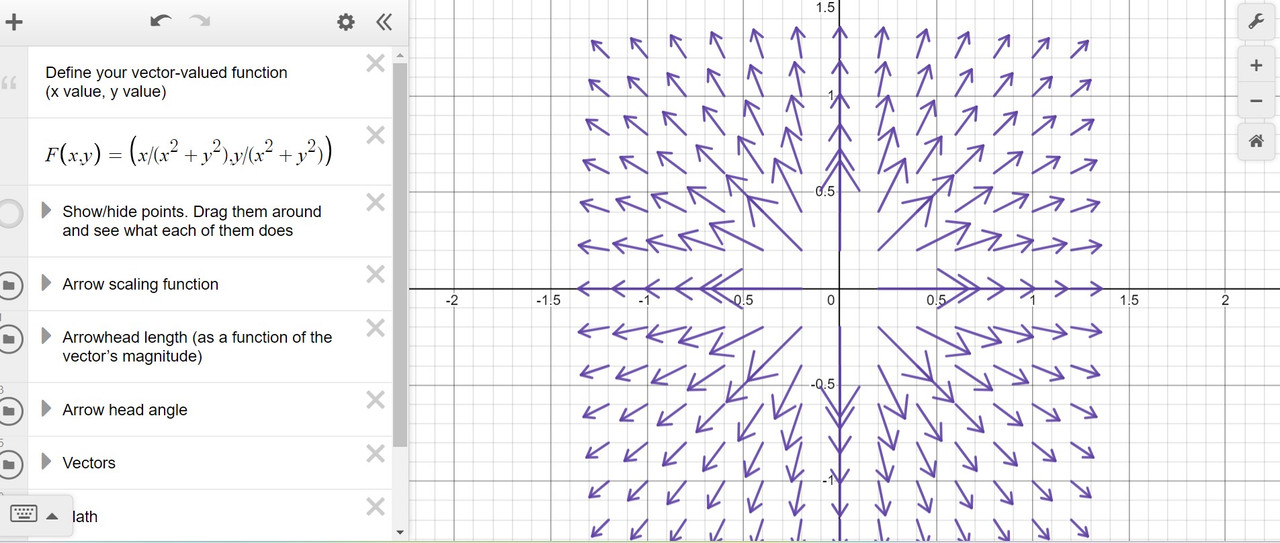
However, when I graphed the vector field online, I found that this vector field had a "starburst" pattern as seen in the image below.
(https://i.postimg.cc/pVKGn3GT/Starburst.jpg)
From the graph, it is clear why the curl is zero, but why should the divergence be zero?
If I placed a circle centered at zero, then wouldn't the vector field lines be alligned with the outward unit normal vector to the circle? In that case,there should be a positive divergence and flux.
Any assistance is greatly appreciated. Thank you.

The thing you need to know about this specific vector field $\vec F$ is that its divergence and curl are zero everywhere except at the origin, where they are both undefined. ($\vec F$ itself is undefined at $(0, 0)$, so it is certainly not differentiable there.). That makes the origin an exceptional point, and things behave differently at the origin than elsewhere.
In particular: you are absolutely correct that if $C$ a circle centered at the origin, then the flux through $C$ is nonzero, and you can calculate that flux directly by parametrizing the curve and evaluating the corresponding line integral explicitly. The important detail here is that Green's Theorem does not apply to this situation, because Green's requires that $\vec F$ have continuous partial derivatives throughout the interior of the curve, which is not the case here. Conceptually (and very informally) you can think of this vector field as having all of its divergence concentrated at the origin, where the divergence is "infinite". Since divergence can be interpreted as the source of flux, what's going on is that all of the flux through the circle is coming from that one single point.
However, if $C$ is any closed curve that does not enclose the origin, then the hypotheses of Green's Theorem are satisfied, and since the divergence of $\vec F$ is zero everywhere throughout the interior of $C$, the flux through such a curve will be zero.