Note: I need to use the double integral method of integration for this.
Let's say I have a function in terms of $r$ and $θ$: $f(r, θ)$
For a rectangular function $f(x, y)$, one can use the following formula to find the surface area:
$$\int\int_D\left(\sqrt{f_x^2+f_y^2+1}\right)dA$$
Is there a formula for doing it with a function of $r$ and $\theta$?
Update:
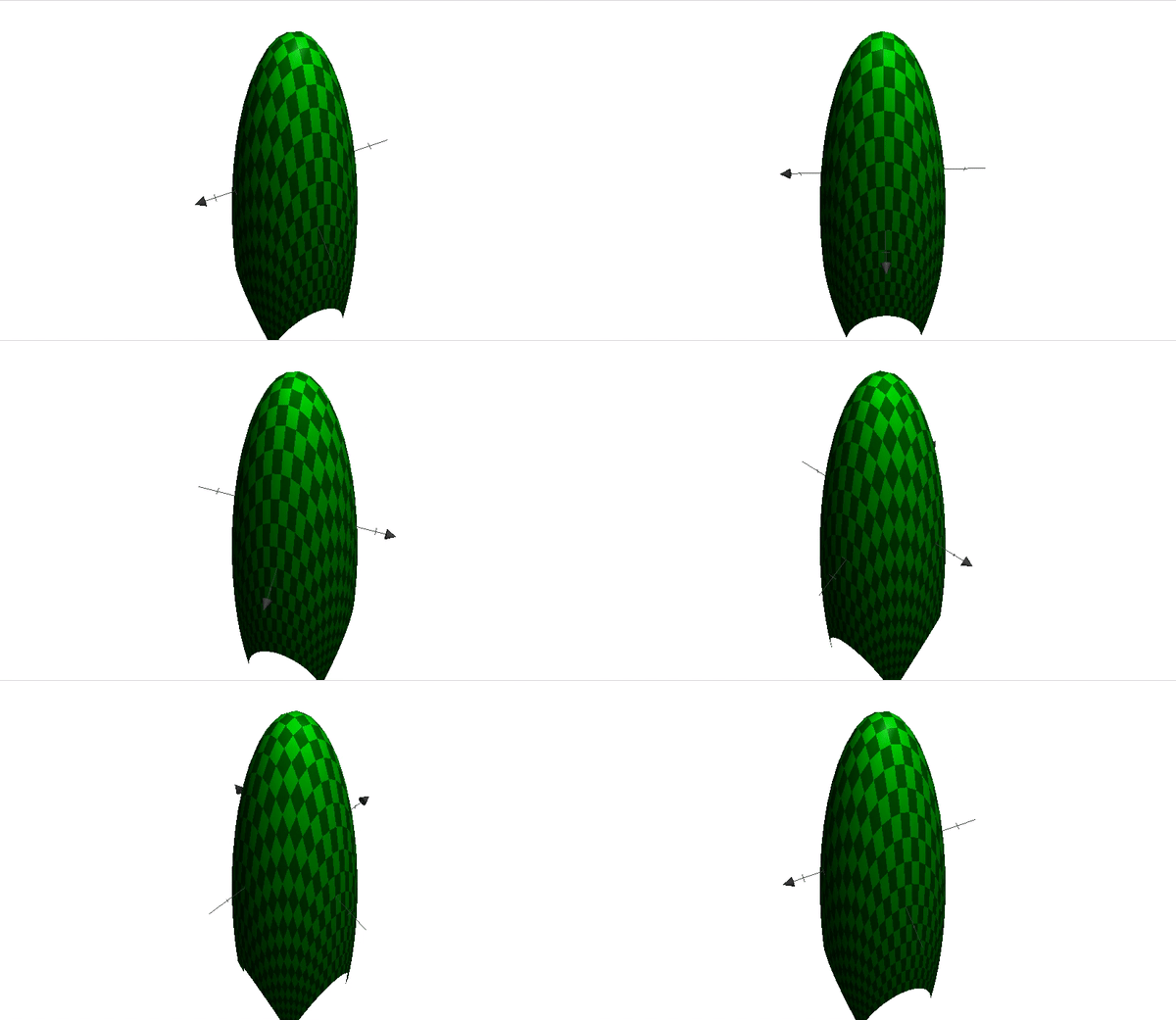
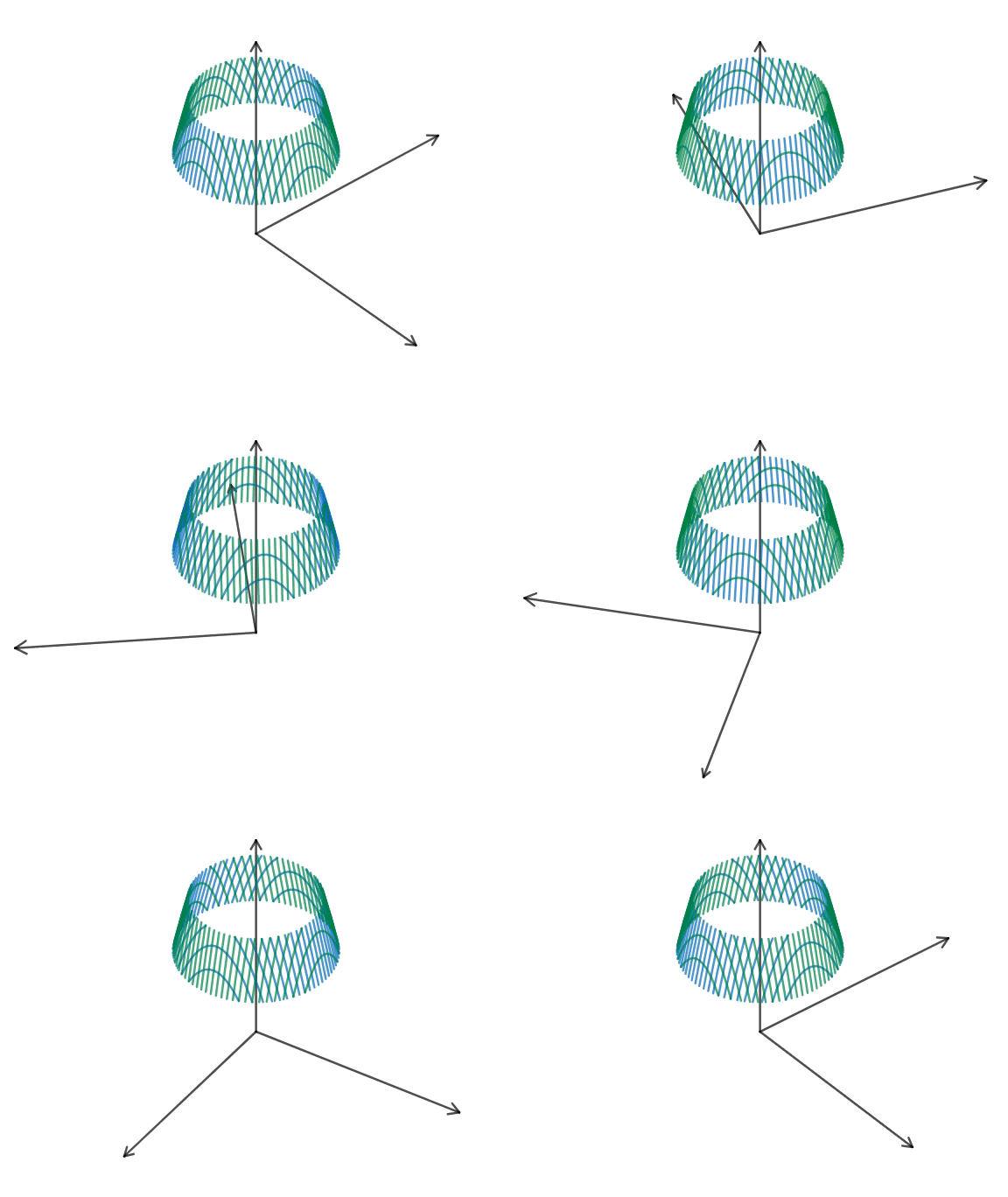
Let's say we have the function $f(r, θ)=9-r^2$ and have the restriction $2≤r≤\sqrt{6}$.
So, it would go from this to this.
So, to answer the question of what I am looking for, let's say I want the surface area of the function, I would want the surface area of the above function with the above restriction. It could probably somehow be done using the same reasoning that one uses the substitution rule, but I do not know how to do this.

If your surface $S$ is given in the form $z=f(r,\theta)$, where $r$ and $\theta$ are polar coordinates in the $(x,y)$-plane, then this is equivalent to a parametric representation $$(r,\theta)\mapsto {\bf r}(r,\theta)=\bigl(r\cos \theta,r\sin\theta, f(r,\theta)\bigr)$$ with a domain $D$ to be specified by inequalities referring to $r$ and $\theta$. For the area element on $S$ we have to compute $${\bf r}_r=(\cos\theta,\sin\theta, f_r\bigr),\qquad {\bf r}_\theta=\bigl(-r\sin\theta,r\cos\theta,f_\theta\bigr)$$ and then $${\bf r}_r\times{\bf r}_\theta=\bigl(f_\theta\sin\theta -rf_r\cos\theta ,-r f_r\sin\theta-f_\theta\cos\theta,r\bigr)\ ,$$ so that $$|{\bf r}_r\times{\bf r}_\theta|=\sqrt{r^2(1+ f_r^2)+f^2_\theta}\ .$$It follows that the area of $S$ is given by $${\rm area}(S)=\int_D\sqrt{r^2(1+ f_r^2)+f^2_\theta}\>{\rm d}(r,\theta)\ .$$