Cross posted from physics on suggestion of a commenter. However, please explain any topology terminology in the answers for a non-expert!
I've been trying to wrap my head around Poincaré Dodecahedral Space, aka the Poincaré homology sphere, which was suggested as a cosmological model after the release of WMAP cosmic microwave background data but contradicted by the improved Planck mission data. This is commonly described as gluing opposite faces of a dodecahedron, e.g. this figure from The Shape of Space by Jeffrey R. Weeks (reproduced here):
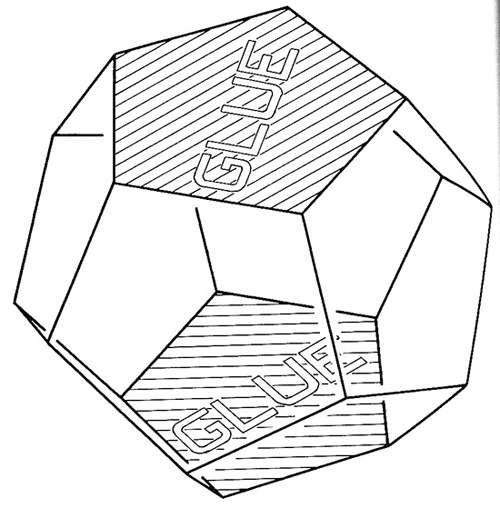
Since this is a 3-manifold, it must locally look like euclidean space. However, I don't understand how this is possible near the corners. It seems like mapping points near a corner to the opposite sides of the dodecahedron will result in points far apart. For instance, given the labels from this figure (Threlfall & Seifert, 1931, pg 66, uploaded here):

if we consider the center corner I, it is surrounded by $C_1^+$, $C_3^+$ and $C_4^+$. However, applying the glue operation we get the other three I corners, each of which is bounded by a different set of faces.
Does this imply that it's not just the opposing faces which are glued, but that there are actually 4 equivalent positions for any point in the dodecahedron? That seems wrong to me, since then the actual space would be something like three pentagonal pyramids merged and you'd get a singularity at the center. What am I overlooking here?

I don't quite understand what any of these sentences means:
But hopefully this answers your question anyway: yes, there are $4$ equivalent positions for every corner. This gluing is a topological (or smooth) gluing, not a geometric one; it doesn't know anything about angles and so forth. The dodecahedron here is not "rigid," it is allowed to bend and stretch as necessary.
This is related to the fact that unlike, say, the cube, whose opposite faces can be identified (rigidly!) to get a $3$-torus, in such a way that angles add up and so forth, dodecahedra can't tile Euclidean space. Dodecahedra can tile hyperbolic space, and the Seifert-Weber space is a $3$-manifold which can be constructed using such a tiling, the order-$5$ dodecahedral honeycomb. But as it turns out, no such tiling produces the Poincare homology sphere, because its universal cover is the $3$-sphere $S^3$ and so can't be either Euclidean or hyperbolic $3$-space.
The Poincare homology sphere can be given a geometry but it has positive curvature (spherical) rather than zero (Euclidean) or negative (hyperbolic); to do this you can construct it as the quotient of $S^3$ by an isometric action of the binary icosahedral group, which can e.g. be constructed using quaternions.