I'm learning about products of CW complexes. The sources I've seen talk about the matter as follows: given topological spaces $X$ and $Y$ with a given CW decomposition, we can then form a CW decomposition of $X \times Y$ by understanding the characteristic maps as the product maps.
OK, but starting with $X \times Y$ and then breaking it down into cells assumes (perhaps) that we have some notion of what $X \times Y$ looks like. I'm interested in understanding the structure of $X \times Y$ by inductively building a cell complex. For the most part, the attaching maps seem pretty hard to wrap my head around. OK, these things are hard to visualize, but it's nice to try.
Suppose I don't know what $S^1 \times S^2$ is like (I don't). I try to get a handle on its cell decomposition, using for $S^1$ and $S^2$ the decompositions with two cells each. To build it, I'd start with a $0$ cell, attach a $1$ cell like a circle, and then attach the two skeleton which is a single $D^2$ with boundary collapsed to a point. So the two-skeleton is $S^1 \vee S^2 $.
Now I should attach a solid tube like a cannoli, and I'm trying to understand the attaching map. The boundary of the tube has two flat sections $D^2$ and one curvy section $S^1 \times I$. I need to attach the flat parts to the sphere and the curvy part to the circle. Essentially I have a solid doughnut where I identify every boundary point that has the same position in the big circle?
Is it productive for me to try to visualize things this way? I'm kind of banging my head against it.

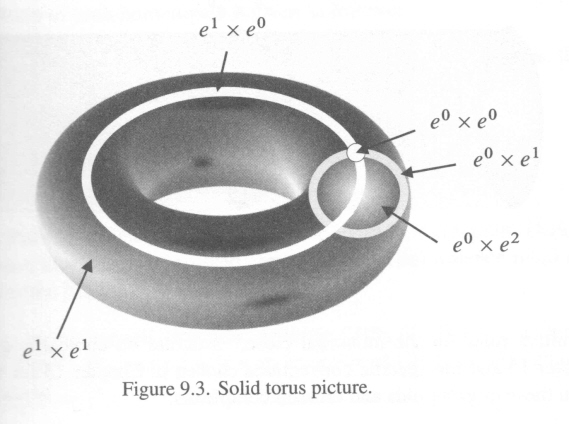 taken from the book
In most cases visualizing CW-complex skeleta-by-skeleta in the way you described is pointless (look at Mike's comment). However there is a formula for doing that, namely:
let's denote by $\chi_{X^{(n)}}^{i} : S^{n-1} \to X^{n-1}, \chi_{Y^{(n)}}^{j} : S^{n-1} \to Y^{n-1}$ the attaching maps where $i \in I_{n}, j \in J_{n}$ are indices of them. We are defining:
$$(X \times Y)^{(n)} = \bigcup_{k + l = n} X^{(k)} \times Y^{(l)}$$
with attaching maps: $$\chi_{X \times Y ^{(n)}} = \bigsqcup_{k + l = n - 1} \bigsqcup_{i \in I_{k}, j \in J_{l}} \chi_{X^{(n)}}^{i} \times \chi_{Y^{(n)}}^{j}$$
observe that we are attaching all the $n$-cells here at once and that these products of attaching maps can be defined in canonical way because of the following observation:
$$(D^{k + l}, S^{k + l - 1}) = (D^{k} \times D^{l}, S^{k - 1} \times D^{l} \cup D^{k} \times S^{l - 1}).$$
Try to decompose $S^1 \times S^2$ in that way. I doubt whether there is a better method for insight into product skeleta.