Functions from $\mathbb{C} \rightarrow \mathbb{C}$ are hard to visualize because of their 4-dimensional nature. One nice way of looking at them is by what's called domain coloring. An example from the wiki article is shown below.
When we look at the graph of a real function ($\mathbb{R} \rightarrow \mathbb{R}$), we can get a feel for some of the function's properties: where its zeros are, if it's continuous, if it's differentiable, etc.
My question is what kinds of properties of complex functions can we "see" by looking at a domain coloring? In the example below, we can obviously see where the zeros are and where it blows up. I'm wondering, can we tell if a function is analytic? A rational function? Can we estimate an integral like we could by looking at a real graph?
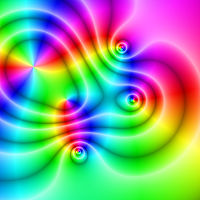
$f(z) = \frac{(z^2 − 1)(z − 2 − i)^2}{(z^2 + 2 + 2i)}$

Hans Lundmark's pages on domain coloring, and his page on Elliptic functions is good places to start. (Picard's great theorems, Lucas's theorem, Weierstrass $\wp$ function)
I don't think we can see that a function is rational -- just moving the roots in the function that you have displayed above by $\pi/100$ in some random direction would be sufficient to make it not a rational function, but the picture would more or less look the same.