Obviously, a lot of people are very interested in algebraic geometry. I suppose this means it is a fascinating area. However the few times I have tried to read introductory books and/or articles in the area, I haven't been able to "get it" or even to see what all the fuss is about. It seems pretty technical.
A few questions for those who are involved in algebraic geometry:
- What was your first exposure to algebraic geometry, and did you immediately like it? If not, what made you go back and study it later?
- What problems, ideas or questions first got you interested in the field?
- Can you recommend a strategy for breaking into the field such that the material will seem as well-motivated as humanly possible?

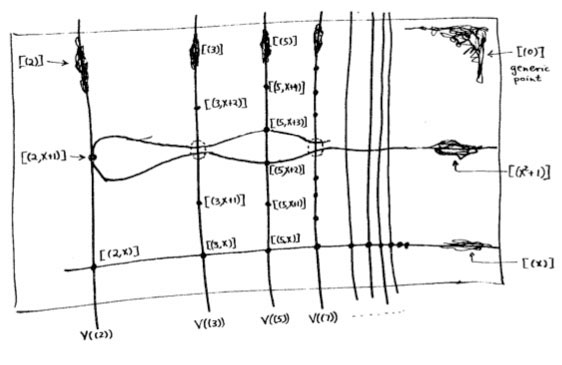
I went through a bunch of geometry-type courses in college (physics, differential geometry, parts of algebraic topology, etc.) and really just had absolutely no idea what anyone was talking about. People would give very non-rigorous arguments for things and I'd end up having no idea quite what they were actually saying. Sure, it sounded reasonable when they described things, but when I tried to do the same things I'd end up with four different answers and no idea which was correct.
So for several years I gave up on geometry entirely, secretly harboring severe doubts as to how much of it was even true.
Years later, I was in grad school with the idea of doing something purely algebraic and totally unconnected to geometry. I had some free time and decided to stop by the library. Occasionally I'd do this, picking out a math book at random to see if I could get some idea of what it was about. On this occasion, I picked up Daniel Perrin's Algebraic Geometry. (For those who aren't familiar, the book is unlike a lot of others in that it starts out with an actual proof of the Nullstellensatz, instead of assuming the reader is already familiar with commutative algebra). For the first time in my life, I was seeing geometric arguments where I could actually check each step and satisfy myself that they made sense; there was no ambiguity about what was being done, I wasn't asked to "imagine deforming such-and-such a little bit, which will obviously have a non-negligible effect on this and a negligible effect on that..."
Having this tiny foothold let me do a number of things. For one thing, I could see the geometric ideas motivating a lot of things I've previously thought of as miraculous formal tricks. (I'm pretty sure that, up to that point, I hadn't even understood that the Fundamental Theorem of Calculus was something other than clever pencil-pushing!) For another, I could go back and now see what people meant when they described geometric arguments informally.
I ended up transferring to a different grad program when I was nearly A.B.D. and just almost starting over. I'll be older than I'd like by the time I'm applying for postdocs, but I'd do it again; it was worth it to understand the geometry. I just wish I could have learned all this a little bit earlier and avoided wasting so much time.
Regarding "getting started," I recommend the following:
There are a couple of things you'd need to learn at this point that I've never seen written down in a way I consider satisfactory. These include how to prove things about schemes (first, reduce to a local commutative algebra problem, then quote some deep theorem from commutative algebra you've probably never heard of before); how to work with vector bundles; the general ideas of homological algebra; etc. These are all things I tried to learn out of books forever and only ever learned once I had someone who could explain them to me.