Which mathematicians have influenced you the most?

5.5k Views Asked by At

This question is lifted from Mathoverflow.. I feel it belongs here too.

There are mathematicians whose creativity, insight and taste have the power of driving anyone into a world of beautiful ideas, which can inspire the desire, even the need for doing mathematics, or can make one to confront some kind of problems, dedicate his life to a branch of math, or choose an specific research topic.

I think that this kind of force must not be underestimated; on the contrary, we have the duty to take advantage of it in order to improve the mathematical education of those who may come after us, using the work of those gifted mathematicians (and even their own words) to inspire them as they inspired ourselves.

So, I'm interested on knowing who (the mathematician), when (in which moment of your career), where (which specific work) and why this person had an impact on your way of looking at math. Like this, we will have an statistic about which mathematicians are more akin to appeal to our students at any moment of their development. Please, keep one mathematician for post, so that votes are really representative.

16

There are 16 best solutions below

5
On

Isaac Newton

I'm not going to give a complete biography, but for those who don't know...

  • He single-handedly discovered The Calculus. Of course while at the same time, Leibniz "single-handedly" discovered it too. :)
  • He theorized the connection between an object's tendency to fall to the earth and the motion of the heavenly bodies.
  • Studied the laws of motion and developed formulas we commonly use today
  • Investigated light refraction
  • Calculated the speed of sound to less than 1% the experimented value
  • He used the "dot notation" to signify time derivatives, which I prefer far over prime notation. :)
8
On

Benoît Mandelbrot

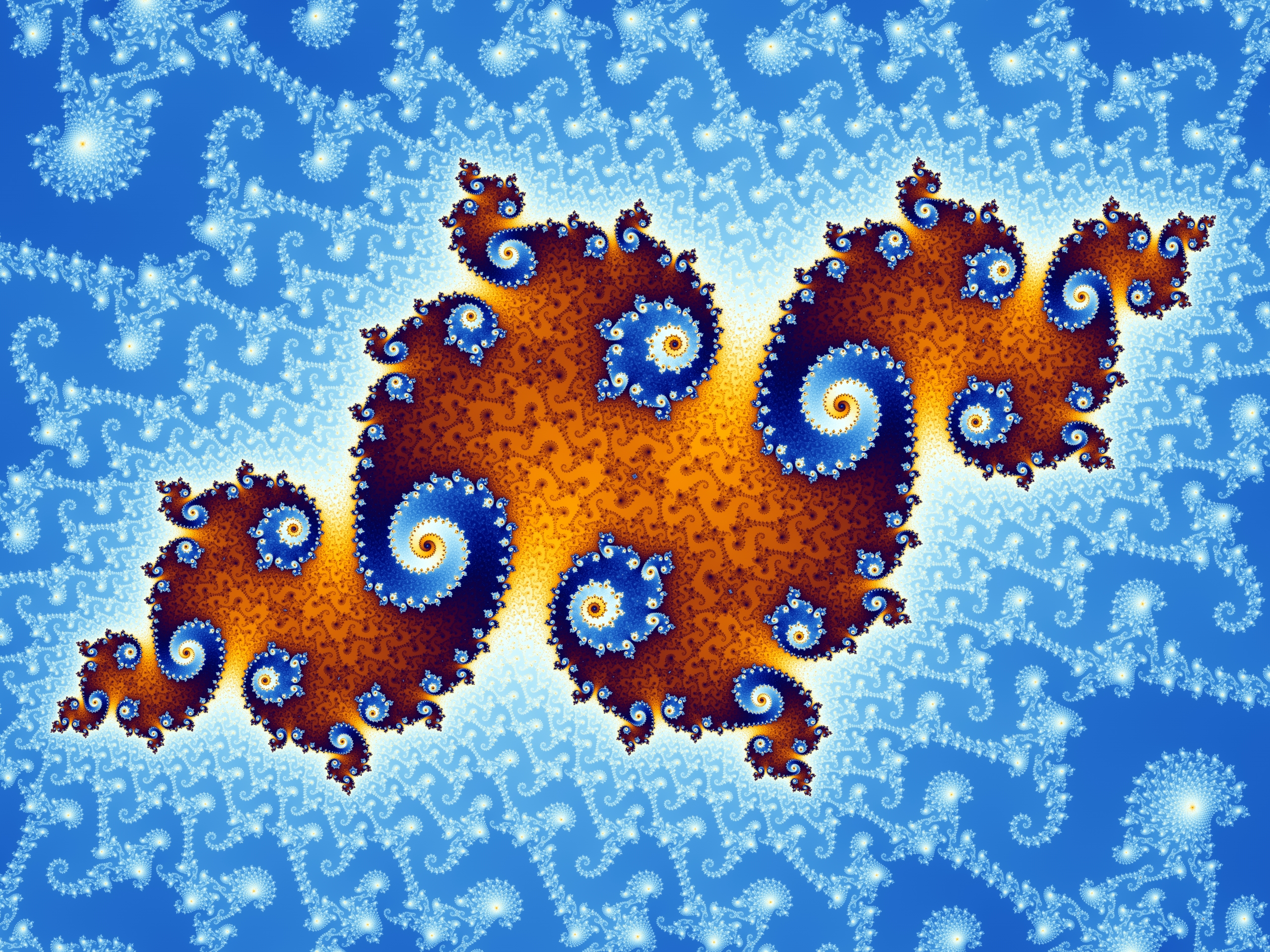
Although he provided many valuable contributions to the field, I am most in love with his work on Fractals. I find math to be quite beautiful, and the Mandelbrot Set (magnified portion shown below) is a perfect example:

mandelbrot set zoom 14: julia island

3
On

Leonhard Euler


  • He made important discoveries in pretty much every mathematical field there was at his time.

  • He discovered graph theory.

  • He is responsible for much of the current mathematical notation we use today, including Σ, i, e, f(x), π, and sin/cos.

  • EVERYTHING is named after him

  • His combined works fill 80 (!) volumes.

  • And last but not least,

    (Euler's formula)

1
On

Nicolas Bourbaki

The story had me from the moment I realized it is true. And as I come to understand more mathematics, I find that I frequently ask myself "What would Bourbaki do?" Also, the individuals have done much to expose the human side of mathematics.

1
On

David Hilbert

Hilbert worked in many areas of mathematics (both pure and applied) and his work on the "Hilbert Program" contributed significantly to the development of modern logic.

I find him particularly inspiring because he serves a reminder that creativity and imagination are important qualities for mathematicians to possess-according to one story, a mathematics student decided to instead become a novelist, to which Hilbert is reported to have replied "He did not have enough imagination for mathematics, but he had enough for novels" (see Constance Reid's book" Hilbert").

0
On

Perelman:

He is a truth seeker and does math for the beauty that lies underneath. Its not about Poincare conjecture, but his philosophy and approach towards things in life.

Similar other figures I consider as having influenced me are Leibniz, Einstein, Russell, Grothendieck, etc. Although not all of them were mathematicians!!!

1
On

Paul Erdős


"I know numbers are beautiful. If they aren't beautiful, nothing is."

My favorite math teacher as an undergraduate was Hungarian, and he is the person who first turned me on to Erdős. I remember the first time I checked out volume one of Erdős collected works from the library, it was like a had discovered a lost treasure trove!

I just love the types of problems he worked on; he was amazingly prolific, and the stories about him and his personality that have survived make him seem like a really special person.

There are many funny things about the way Erdős spoke; for example he called children "epsilons", and he said that anyone who was married was "captured"!

Erdős famously said that God keeps a book of every theorem that will ever be discovered by man, but that there is only one proof in the book for every theorem! These are the book proofs, and this idea has inspired me ever since I heard about, to always look for book proofs whenever possible.

Erdős was so prolific, that every mathematician has an Erdős number, which "describes the 'collaborative distance' between a person and mathematician Paul Erdős, as measured by authorship of mathematical papers."

1
On

Évariste Galois is the mathematician that had influenced me the most. When I was in 10 grade, I bought a book that tells the story of Galois's life. Despite some information in the book are not correct, I still loved Galois's personality, and I admired his concentration. He could do mathematics even in prison.

1
On

Emmy Noether

I find it surprising, given Hilbert's mention, that nobody's yet included his most famous algebraist associate.

Over the course of a busy and prolific mathematical career, Noether revolutionised abstract algebra. (It is impossible to describe the limits of her influence on modern abstract algebra; there are none.) She performed nearly as brilliantly in topology. Noether's Theorem is critical in the development of modern physics of dynamical systems.

But I find her inspiring for her skill as a teacher. Noether was a determined and passionate teacher, who led lectures by discussing current active problems openly and in detail with her students. She was also known for being endlessly patient with her students, and several of her students went on to make critical contributions of their own. (When the Nazis made it impossible for a Jew to teach at university, she calmly shifted to holding classes at her house - and then moved to Princeton, returning to Gottingen only as a visiting foreign academic.)

Noether was profilic and generous with her ideas, frequently passing critical work, and credit for her ideas, to students or colleagues - even when it meant developing their careers ahead of her own. This means she had a direct and indirect impact in several fields superficially unrelated to the work she's most famous for. (All this despite dealing with the misogynist prejudices of her time, which lead to her working unpaid at Gottingen for years, and lecturing under Hilbert's name rather than her own.)

0
On

$\Large{\text{János Bolyai}}$

When Bolyai began puzzling over Euclid's fifth postulate he managed to set up his own definitions of 'parallel' and showing that if the Fifth Postulate held in one region of space it held throughout, and vice versa.

He has been quoted as writing;

"Denote by Σ the system of geometry based on the hypothesis that Euclid's Fifth Postulate is true, and by S the system based on the opposite hypothesis. All theorems we state without explicitly specifying the system Σ or S in which the theorem is valid are meant to be absolute, that is, valid independently of whether Σ or S is true."

Bolyai was witnessing before his very eyes a new and more substantial universe than the mathematicians up to that point had been aware of. His "Out of nothing I have created a strange new universe" quote will go down in history, yet many don't know or appreciate Bolyai's legacy.

Between 1820 and 1823 he prepared a treatise on a complete system of non-Euclidean geometry and published in 1832 was an appendix to a mathematics textbook that, when Gauss had read his publication wrote to a friend saying "I regard this young geometer Bolyai as a genius of the first order".

Although he never published more than the few pages of the Appendix he left more than $20,000$ pages of manuscript of mathematical work when he died. It is my belief that without the work of Bolyai, non-Euclidean geometry would be set back many years and given his work was acknowledged by Gauss as being of great importance, he should be remembered and celebrated.

Non-Euclidean Geometry Euclid's Parallel Postulate

7
On

LEONARD EULER, is not only his intelligence but the 'formal' way he did everything

Another 'formal' mathematician is RAMANUJAN, I think that things should also be taught in 'formal ' proofs , which are easier to understand and to work with ...

0
On

John Horton Conway

It's no great stretch to call Conway the Erdős of recreational mathematics; from the game of Life to surreal numbers and combinatorial game theory to the 'angel problem', he's made immense contributions across the board both in solving interesting problems and in suggesting them. But that substantially underestimates his contributions elsewhere, especially his work on Moonshine and his other contributions in finite simple groups, knot theory, the Leech lattice... the list really goes on and on.

What I admire Conway most for, though, is his astonishing skill at communication. His writing has a light, breezy tone to it that belies the depth of the ideas he communicates with it, and I've never read a book of his — no matter how abstruse the subject — that wasn't an absolute delight. Even his denser technical work (e.g., Sphere Packings, Lattices and Groups) communicates its subject matter with an ease that makes it a joy to try and work through. We're seeing more and better mathematical writing these days than we've ever seen before, but there still aren't more than a handful who can even come close.

1
On

Srinivasa Ramanujan

These quotes says it all

Quoting K. Srinivasa Rao, "As for his place in the world of Mathematics, we quote Bruce C. Berndt: 'Paul Erdős has passed on to us Hardy's personal ratings of mathematicians. Suppose that we rate mathematicians on the basis of pure talent on a scale from 0 to 100, Hardy gave himself a score of 25, J.E. Littlewood 30, David Hilbert 80 and Ramanujan 100.'"

"In mathematics, there is a distinction between having an insight and having a proof. Ramanujan's talent suggested a plethora of formulae that could then be investigated in depth later. It is said that Ramanujan's discoveries are unusually rich and that there is often more to them than initially meets the eye."

Hardy said : "The limitations of his knowledge were as startling as its profundity. Here was a man who could work out modular equations and theorems... to orders unheard of, whose mastery of continued fractions was... beyond that of any mathematician in the world, who had found for himself the functional equation of the zeta function and the dominant terms of many of the most famous problems in the analytic theory of numbers; and yet he had never heard of a doubly periodic function or of Cauchy's theorem, and had indeed but the vaguest idea of what a function of a complex variable was..."

4
On

Two answers:

Bernhard Riemann

Mathematics has no shortage of poor, brilliant young men who died too early. Riemann had every disadvantage, yet, along with Cauchy, was largely responsible for Complex Analysis as we practice it today. His treatment of multivalued functions is so brilliant. And still, there is that matter of the problem with his name on it...

Cornelius Lanczos

This one may be a bit obscure to some of you. He labored for many years at Boeing after WWII, but taught at Purdue and the Dublin Institute of Advanced Studies. He pioneered the Fast Fourier Transform as practiced today, and many implementations of mathematics in computers today use algorithms he published first, 60 or more years ago. He also had a fascinating personal life, unfortunately largely due to his Hungarian and Jewish roots.

(Sorry, you asked us to keep it to one, but I had a hard time keeping it to two.)

1
On

There are so many mathematichans who inspired (and still inspire) me (some of them are already mentioned here) and it is hard to pick the one who inspired me the most. Hilbert was already mentioned, allmost all of the Bourbaki members, mainly Grothendieck and Serre (!), of course Euler and Riemann. (I love reading Mumfords Curves and their Jacobians, knowing that Riemann draw the same pictures long time ago.) Hardy inspired my way of thinking about mathematics even though I didn't read one of his mathematics, but what he is talking about mathematics, also Gödel and Wittgenstein have to be mentioned here. It is time to pick one, and there is still a wide range of: Poincaré, Deligne, Milnor, Weyl, Hirzebruch, Atiyah,$\dots$;

Let me tell you something about the underestimated german mathematician

Hans Grauert.

The man behind the fundament and standard technology in analytical complex geometry. I won't forget to mention the contributions by Oka, Cartan, Serre, Stein and Remmert, but still, Grauert's intuition (behind the direct image theorem for example) is indisputably one of the most inspiring and motivating mathematics for me. He had so many ideas, coming from his way of thinking about the complex spaces, reading one of his articles, it seems like he had them so much earlier and just didn't find the time to write them down earlier. Luckily he did! My mathematical universe and mathematical interests wouldn't be the same without him, as the one of many others would too, but they don't even know.

0
On

Bruno de Finetti

His name is not well-known as the others mentioned here. At the end of the sixties, he organized a series of mathematical lectures, given by various academics, for high school students in Rome. They were extremely interesting and entertaining, and motivated me to study Mathematics.

I remember in particular a cycle of three lectures on $e, \pi, i$ he gave in September 1970, just before I started University. He taught us in particular about Euler's identity, of course. Financial Matematics being one of his forte, he suggested that an ingenious swindler might have planned a financial scheme in which he was offering an imaginary interest (the pun translates well from Italian) on an investment.

So every time I think of the function $x \mapsto e^{ix}$, for $x$ real, my memory goes back to those lectures, and a smile invariably appears on my face. And of course I have learned from him that cracking a joke may be a good way to help conveying a difficult concept.