I am modelling a rocket model. Consider a solid rocket motor, (let us for sake of simplicity assume that the propellant is distributed in the case with a cylindrical shape: see shape in fig.1 of the image http://www.braeunig.us/space/pics/fig1-14.gif.
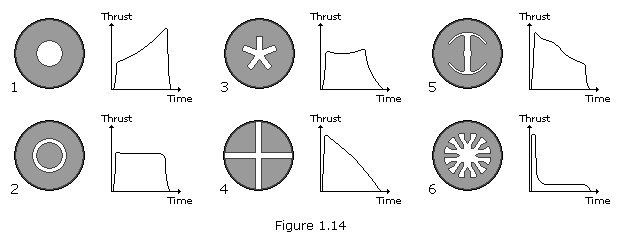
Let us assume $R_{int},R_{ext}$ (the internal and external radii) to be known and fixed.
The propellant at time t=0 has an initial burning area $A_b(0)=2\pi L R_{int}$, where L is the length of the cylinder, also known.
The propellant burns progressively increasing the instantaneous burning area $A_b(t)=2\pi L(R_{int}+W)$,where W is the web distance defined as the amount of propellant burned as measured normal to the local burn surface.
The burning rate (regression rate) of the propellant is given by: $r(t)=a P_c^n$, where a and n are constant and $P_c(t)$ is the pressure of the gas during the combustion that is given by: \begin{equation} P_c(t)=\left(a\rho_pc^*\frac{A_b(t)}{A_g}\right)^\frac{1}{1-n} \end{equation} where $\rho_p, c^*, A_g$ are known.
Finally, W is given by: \begin{equation} W(t)=\int_0^t r(s)ds \end{equation} The specificity of this problem is that we do not known the total burning time $t_b$ of the problem, but we do known that it will end only when $R_{int}+W(t_b)=R_{ext} $
How can I solve this set of differential equation? I mean, how can transform those equation in a standard set of differential equation that I can solve applying standard numerical methods (runge-kutta-ecc). (I don't think so, but are there theoretical solutions?)
Finally, how the problem could be solved, if we assume a generic shape for the propellant, such those shown in the previous link? (I guess that is much more difficult)