A Von Dyck group is a subgroup of the triangle group. For example $D(2,3,7)$ can be represented as the black triangles in
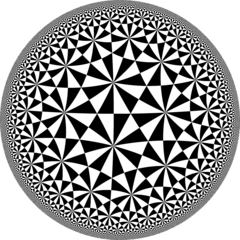
by picking an arbitrary black triangle as the identity element. Each triangle then corresponds to the isometry mapping the identity triangle to it.
The $D(l,m,n)$ is isometry group can be generated by two rotations, a rotation $x$ of $\frac {2 \pi} m$ radians (around the vertice of the identity triangle of angle with angle $\frac \pi m$) and the rotation $y$ of $\frac {2 \pi} y$ (around the vertice of the identity triangle of angle with angle $\frac \pi y$). Then the group can be repersented as
$\langle x,y | x^m = y^n = (xy)^l = 1 \rangle$
My question is, given an element of $D(l,m,n)$, represented by a string of $x$ and $y$, how can we tell if the triangles they represent share a vertice, and if so, which one? (I am particularly interested in the case $l=2$, but a general answer would be nice.)
I think it has something to do with conjugates, but I'm not sure.