Are all integers fractions?

15.5k Views Asked by At

In a college class I was asked this question on a quiz in regards to sets:

All integers are fractions. T/F.

I answered False because if an integer is written in fraction notation it is then classified as a rational number. The teacher said the answer was True and gave me the link http://www.purplemath.com/modules/numtypes.htm. As a teacher of mathematics in the K-12 system I have always taught that integers were all whole numbers above and below zero, and including zero. All of the resources I have used agree to my definition. Please clarify this for me.

What is the truth, or are she and I just mincing words?

9

There are 9 best solutions below

3
On

Integers are a subset of rational numbers. This doesn't make them not-rational numbers.

0
On

Integers are fractions, because a number is itself no matter how you write it.

A relevant section from Lockhart's A Mathematician's Lament:

In place of a natural problem context in which students can make decisions about what they want their words to mean, and what notions they wish to codify, they are instead subjected to an endless sequence of unmotivated and a priori “definitions.” The curriculum is obsessed with jargon and nomenclature, seemingly for no other purpose than to provide teachers with something to test the students on. No mathematician in the world would bother making these senseless distinctions: 2 1/2 is a “mixed number,” while 5/2 is an “improper fraction.” They’re equal for crying out loud. They are the same exact numbers, and have the same exact properties. Who uses such words outside of fourth grade?

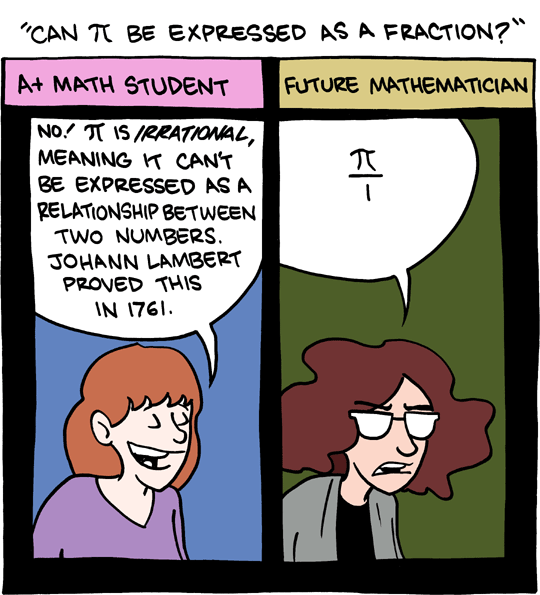
Here's a relevant comic from SMBC:

Header: A+ Math Student / Woman #1: "No! Pi is IRRATIONAL, meaning it can't be expressed as a relationship between two numbers. Johann Lambert proved this in 1761." / Header: Future Mathematician / Woman #2: "pi/1"

5
On

Every integer $x \in \mathbb Z$ can be expressed as the fraction $x \over 1$

1
On

The important question is what is a fraction. If it is any number that can be expressed as $\frac ab$ with $a,b$ integers, then any integer $c$ can be expressed as $\frac c1$. If the fractions exclude the integers, integers are not fractions.

1
On

$$ \begin{align} -7 &= \frac{-7}{1} \\ 0 &= \frac{0}{1}\\ 1 &= \frac{1}{1} \\ 4 &=\frac{4}{1}\\ \end{align} $$ Note here the $=$. So for example $-7$ is indeed an integer and as a number (element in the set of integers) it is the same as $\frac{-7}{1}$. It is not about thinking about numbers in different ways.

6
On

I want to point out a different perspective. This is a typical issue where non-rigorous use of language leads to confusion. We often treat objects that are equivalent (under a possibly unspoken equivalence relation) as if they are equal.

Integers and rational numbers are not fractions, in the strictest sense of the word "are". For example, the fractions $1/1$, $4/4$, and $8/8$ are all different fractions, but they all represent the same integer. (Actually, I should say "the fractions represented by the expressions $1/1$, $4/4$, and $8/8$.") None of the fractions $1/1$, $4/4$, and $8/8$ literally is the integer 1. If they were all the same as the integer $1$, they would all be the same as each other - but they are not, because they are different fractions. What is true is that they have the same value as each other.

Similarly, the fractions $1/2$ and $2/4$ are not both the same as the rational number $1/2$, because they are not the same as each other, because they have different numerators. Who would claim that a rational number has a numerator?

When we write $$ 1 = 4/4 = 8/8 $$ the "equals" there only means that fractions represent the same number (they have the same value), not that they are the same fraction. In other words, the $=$ we write is actually an equivalence relation on a set of fractions - the equivalence relation being "has the same value". We have no symbol that we typically use to denote "actual" equality of fractions. This point is often ignored completely in lower-level texts.

The first place that people start to consider these things in detail is in abstract algebra. In that context, we run into many interesting distinctions that would not be visible in elementary math. For example, under the definitions in most algebra books, $\mathbb{Z}$ is an extension of the semigroup $\mathbb{N}$ to a group; $\mathbb{Q}$ is the field of fractions of $\mathbb{Z}$; and $\mathbb{R}$ is the Dedekind completion of $\mathbb{Q}$. It follows from these definitions that the natural number 1 is not the same as the integer 1, both are different than the rational number 1, and all three of those are different from the real number 1.

0
On

The set of rational numbers can be partitioned into the set of ratios and the set of integers. Five clearly falls into the second partition. So the question is, do you define "fraction" as "ratio" (the first partition only) or as "rational".

I would tend to agree with you and define fractions as being non-integral rational numbers, or ratios.

If an integer is a fraction, that legitimizes nonsense like: 5 is 3, plus a fractional part of 2.

Also, note that we never say that numbers are divisible by 1. Prime numbers simply have no divisor, and two relatively prime integers have no common divisor, and that is that. The phrase "other than one" is added so that school children don't get excited. "Fractions" with a denominator of 1, do not count, in a certain sense.

Oh, and by the way, I slipped today and fractured my leg. Luckily, it was fractured in zero places so it is not actually broken. Each bone manifests itself in one whole, healthy fragment!

1
On

I think you have a case to take to the teacher on this based on the teacher's use of the word "fraction" instead of "rational number". All integers are rational numbers also, everyone agrees (or should agree) on that. That is because all integers can be expressed as a ratio of integers. So here's the case:

Is $3$ a binary number?

I'd be surprised if too many people say "yes" to that question. Note that even though $3$ can be expressed as a binary number ($11$), we don't call it a "binary number" unless it is expressed as one.

Similarly, even though every integer can be expressed as a fraction (of integers, even), even mathematicians are likely to agree (for consistency's sake at least) that an integer is not itself a fraction even if it is always a rational number.

0
On

I'll assume by "fraction" you mean "rational number". If you want to be extremely pedantic, the answer is, in some sense, no. We don't really have $\mathbb{Z} \subset \mathbb{Q}$, but rather, we identify the rational numbers of the form $a/1$ with the integers. In cases like this, however, we always say that $\mathbb{Z}$ is a subset of $\mathbb{Q}$, even though it isn't strictly true. It would be pointless to so pedantic to say that integers are not rational numbers.

We have the same thing going on when we ask whether $\mathbb{Q}$ sits in $\mathbb{R}$. But, sometimes when doing math, I find it useful to switch between thinking of things as subsets, and thinking of things embedding into another thing, even when something isn't actually a subset.