Are We Teaching Pre-Calc Wrong?

10.8k Views Asked by At

It took some 1,250 years to move from the integral of a quadratic to that of a fourth degree polynomial. When we jump too fast to the magical algorithm, when we fail to acknowledge the effort that went into its creation, we risk dragging our students past that conceptual understanding. Source.

By the time Newton and Leibniz were developing Calculus mathematicians already knew how to solve particular problems of derivatives and integration. There was a good understanding on the way to resolve problems, too. Newton's teacher, Isaac Barrow, already had some understandings of the topics Newton would push to the perfection. Source.

For me, pre-calc was plugging and chugging trigonometric, geometric, and algebraic equations. Math books follow a rather narrow and strait path across some imaginary border from the province of pre-calc into calculus. As was mentioned already, that historic transition was anything but discreet. Should Pre-Calc teach the foundations of the fundamental theorem of calculus that were known Pre-Lebniz/Newton? I think that would energize what is otherwise a boring exercise in tedious calculation.

A beautiful example of a Pre-Leibniz integration: Who realized $\int \frac 1x dx =\ln(x)+c$?

4

There are 4 best solutions below

6
On BEST ANSWER

We are teaching math wrong in many, many ways.

For some reason, there has been a historical backlash against abstraction in secondary and pre-secondary mathematics. "I'll never need to use this," say so many students and parents.

As a result, what we learn is a hackneyed attempt to apply the mathematical problems to "real world examples."

So when we learn trig, we start talking about things like leaning ladders against houses, and we give students an impression that in order to do such a thing, they need to compute the inverse sin of the height over the length of the ladder.

Of course, by the time students are 14, 15, or 16 years old, they've probably seen someone lean a ladder against a house and do no such thing.


Pre-calculus mathematics is very interesting because it is the first opportunity one has to apply relationships and definitions to problems and to learn how to transform complicated problems into simpler ones. This technique is fundamental no only in mathematics, but in the real world.

At the same time, real-time discovery is often haphazard and chaotic. We don't teach biology in the order it was discovered, principally because we assumed a whole lot of extremely wrong nonsense for most of human history.

The historical motivating factors are not the same as the present ones. Newton and Leibniz were trying to solve specific problems, and they needed new math. But we've solved those problems now, so those motivating factors have perhaps lost their edge.


Instead, we should look at their process, not their imperative. We should be teaching students to ask whether there exists a meaningful relationship between a function and its slope, and whether this can have an effect on a real-world problem. We should teach students about how we can infer new properties from a handful of well-defined conditions. We should teach students to explore "what if..."

Instead, we teach students about billiard balls, ladders, and two-column proofs, as if this bears any relevance to the real world, the mathematical world, or any world. In short, we waste their time. So yes, we're teaching it wrong.


A side story: As a partial counter-example... When I substitute taught math courses, I often got classes full of "Level 2" students, which was a way of saying "remedial". They hated their class, the lessons, the work, everything. So I used to put the Navier-Stokes equations on the board, and I'd tell them that whoever could solve them would win not just $1M dollars, but eternal fame.

I asked the students to name the most popular people they knew. They'd respond with "Avril Lavigne" or "Brittney Spears" or some such.

I asked them if they knew who Sophia Loren was. Or Dom Delouise. Or Patsy Cline. They never heard of them.

I then asked them if they ever heard of Newton. Of Einstein. Of Riemann. Of Euler. They, in fact, did know their names. I told them that mathematics is one of the few ways that your mark can be left on the world permanently. That if you did something truly great, that the high school students in 300 years would be hearing your name.

Of course, none of them really thought they could do that. But it resonated with them, because it made them think, "wow yeah, I have heard of Newton." It made them realize that maybe there was something important, and that unlike being a famous world leader, it was something that was almost purely product of self-actualization.

This context gave them a glimpse into a world they didn't know existed. None of them wanted to compute how to lean a ladder against a house. They wanted to know why math was important -- not microcosmically, but in the context of great things. These were young kids with great thoughts, not computing machines.

I told those students that "yes, it does not matter if you can compute these numbers, but it does matter if you know how." That concept alone motivated them more than anything else, because it showed them that they controlled their own destiny.

For a teenage kid frustrated with school, that's a wonderful feeling. Math is one of the few fields where we can actually deliver that consistently.

11
On

In precalculus the real question is can we fix the bad study habits before its too late. From what I see ( I don't teach it personally) the main danger is apathy. I don't think historical tidbits and/or motivations are really the problem. Sadly, the problem is soceital (here).

Now, when I begin calculus, I take a few minutes to sketch the big idea. It doesn't take too long. The stories of the main characters are interesting and I try to return to them from time to time. That said, think about the problem of making the typical student walk the steps which Isaac walked (or Euler, Galois whoever)... it's just not realistic to suppose the typical student has an inkling of the unbounded curiousity of those individuals.

People who do math and people who make (or discover if you prefer) are not the same. The demarcation is not as stark as black and white, but I know from teaching a few thousand students that the percentage out there which are genuinely interested is very small.

One of the reasons I love this website is that it puts me in contact with that precious minority of students who genuinely enjoy math forsaking some degree-seeking requirement.

I don't want to rain on your parade too much, but I think it's better to spend your energy looking to identify the interested students and work with them one on one.

6
On

There is a good amount of maths in the 'shilling arithmethic' of 1951, (a school text), that one see the mathematicians struggle with. For example, a whole chapter is devoted to the idea of various forms of compound arithmetic (multiplication and division of several units without conversion).

The whole idea that you can take a lengths in furlongs and perches, and multiply these by way of a division directly into acres, roods and perches, whthout conversions, seems totally alien in these days. Yet this whole matter is discussed on a single page in an 1895 arithmetic book. The method for doing this might be described as 'invoice arithmetic', applied twice. So, one first finds the area of 1 furlong by $x$, and then finds $x$ by $y$, eg. Here there is no conversion of units.

   Multiply  5 furlongs 22 perches by 8 furlongs 16 perches.
                                                       4,40

        1 furlong   'costs'   10.0.00     5   costs 50.0.00
       10 chains    'costs'    2.2.00     2   costs  5.0.00   (4
        1 chain     'costs'      1.00     2   costs  0.2.00  (10
                        total                 -------------
                                                    55.2.00

        1 furlong  'costs'    55.2.00     8   costs  444.0.00   
       10 chains   'costs'    13.3.20     1   costs   13.3.20  (4
        1 chain    'costs'     1.1.22     6   costs    8.1.12 (10
                                              ===============
                                              total  466.0.12
           466 acres, 12 perches.

This is the normal method with dealing with added fractions, without means of conversions. Multiplication by parts is usually dismissed as a kind of 'peasent multiplication', but you see from this example, it is perfectly clear what is going on, and faster than most means of converting back and fourth.

One often sees on this list, 'continued fractions', often written in the quite ugly long vincula. There is very little comment (if at all), on 'added fractions' or 'continued numerators', which provide a direct way of dealing with quite large fractions without conversions. I regularly convert things like sixtyfourths into eights and added eights (eg $\frac {35}{64} = \frac 48 \frac 38 = \frac {4 \frac 38}8$).

Decimals are simply added fractions, rather than increasingly large exponents. That is, when we upgrade $1.61$ to $1.618$, we are adding $\frac 8{10}$ to the end of such a fraction. One sees, especially in money, amounts like $£ 5.15\frac 12$, exactly with this meaning: the fraction is against the unit of the last place.

One talks of the sumerian numbers, but totally ignores the fact, that well into the fourteenth century, that the English used a hundred of six scores, and that the great multitude of weights and measures used in pairs or tripples, is as much to avoid using hundred-numbers (eg a weight of seventeen two = 17-2 = 17 stone 2 lb = 240 lb, avoids the hundred lb issue).

Even the idea of 'english number' is given as absurd. That is, to write eg $720$ as vi C (ie six C, where the hundred is six score), rather than 'DC', is taken as entirely strange. Yet there are plenty of examples of this sort of writing in Zupko's "Dictionary of English Weights and Measures".

The sumerian system is not a 'regular base' as we know it, but a 'division base'. The most significant digit is the units, and subsequent places are divisions or added fractions of sixtieths. Division bases have leading siginficant zeros, so 00.01 means 1/60, and 00,00.01 means 1/3600. Yet you often see people translate $44.26.40$ as $160,000$, rather than its correct value of $44 \frac 49$.

One of course, seriously objects to this absurdity of introducing radians into every discussion of angle. Not only is it possible to do angle calculations without such absurd units, but geometry had gone a long way before anyone decided to invent it.

One can do rather complex non-euclidean geometry (including hyperbolic geometry) without recourse to things like $\tanh$ etc or radians. The coherent angle for higher geometry is the fraction of all space, something i usually write in fractions against base 120, to simplify calculations. In such units, i found the solid angles occupied by the vertices of all of the four-dimensional regular polytopes (polychora), well before the cubic radian was known.

In practice, the use of radians and radii simply impede the process: nearly everyone in the real world measure circles by their diameter. You go an buy screws or plates or pipes or whatever, and it is the diameter that is quoted. The unit circular inch is the area of an inch of unit diameter. It is interesting that the Sumerians, according to Sir Thomas Heath, rated the circumference of 'real' circles (ie ones that you could walk around or hold), as if their diameter were 60, and $\pi=3$, ie 180 ells, divided to 24 digits. It is only circles you stand in the middle of (like the sky), that has $360$ degrees = $2(\pi=3) 60$. Yet i have been caught out here even suggesting that formulae for volumes by dimaeter be discussed.

6
On

I like @Arkamis' answer a lot and I'd like to add to it by expanding the ending part of that answer.

Primary and high school mathematics is often seen as a bunch rules and formulas to solve certain problems, and very few teachers give any explanation for those.

For example, a colleague of mine asked her student something along the lines $2^3 \cdot 2^4 = ?$. He was trying hard to remember the formula from his high school, but couldn't. Then she went on with $2^3 = 2 \cdot 2 \cdot 2$, $2^4 = 2 \cdot 2 \cdot 2 \cdot 2$, so $2^3 \cdot 2^4 = (2 \cdot 2 \cdot 2) \cdot (2 \cdot 2 \cdot 2 \cdot 2)$, so we have $7$ twos, so that's $2^7 = 2^{3+4}$. The student's response was, in complete astonishment: "Wow! So that formula actually makes sense!?!".

When P.E. is "taught", it is often customary to learn basics of few sports, do various gymnastic stuff, run around a bit, train a body,... why is mathematics not seen as a polygon to train brain to think, but instead it's a place where they try to pour lots of cryptic stuff in that same brain?

"You'll need it later in life" is a lie for most of the mathematics, unless the student is to become a mathematician, physicist, engineer,... But, thinking in order to solve problems, even if they're not real-life, would be priceless "in life".

And just like the aim of P.E. is not in those results you make there (none of the measured running times or climbing heights will ever be used anywhere), a bunch of theory and formulas should not be the aim of mathematics. We make kids run on P.E. to train their bodies in a certain way; the process of understanding how and why, to train brains, should be the aim of mathematics, not encyclopedic knowledge that can be found on Wikipedia and bunch of other sites.

Students don't need $a^b \cdot a^c = a^{b+c}$, but they do need to understand why it works like that. They need to see that the above "proof" works for the natural numbers, it is good for them to think how would they expand it to integers, maybe even rationals, and then be explained how it is actually done. Sure, it easier to just spit out the formula, but such approach misses the point entirely.

It is worth noting that this is the problem with most schooling. History, for example, is often taught as a combination of dates and names. Lots of boring facts, without concept. In my opinion, it is much more important to explain how Hitler could've happened, than what is the exact date he attacked Poland. It is the understanding of the phenomena that lead to a completely different approach towards Germany than after the WWI. That explanation is important and, more importantly for the scope of this discussion, far more interesting to students.

Geography... I was taught how much coal does Russia export (?!?), but I learned more about countries from "Where in the World is Carmen Sandiego" than I did in school, just like I learned more history in 2-3 years reading of Cracked (a comedy site!) than I did in 12 years of primary+high school. In the end, all I was left with was contempt for that stuff, just like many students are left with contempt for mathematics.

"Why?" is the most important question in the World, and most schools seem to avoid it. Try asking a student "Why?" for an answer (s)he wrote on the blackboard, and they'll immediately try to erase the answer, thinking that "Why?" equals "This is wrong". And that is the true failure of the schooling system.

A bit of context for this answer: I was born and raised in ex-Yugoslavia and Croatia; I've read about schooling systems around the World, but I work at the university, so I'm not part of school education, but I do see the consequences.

Edit:

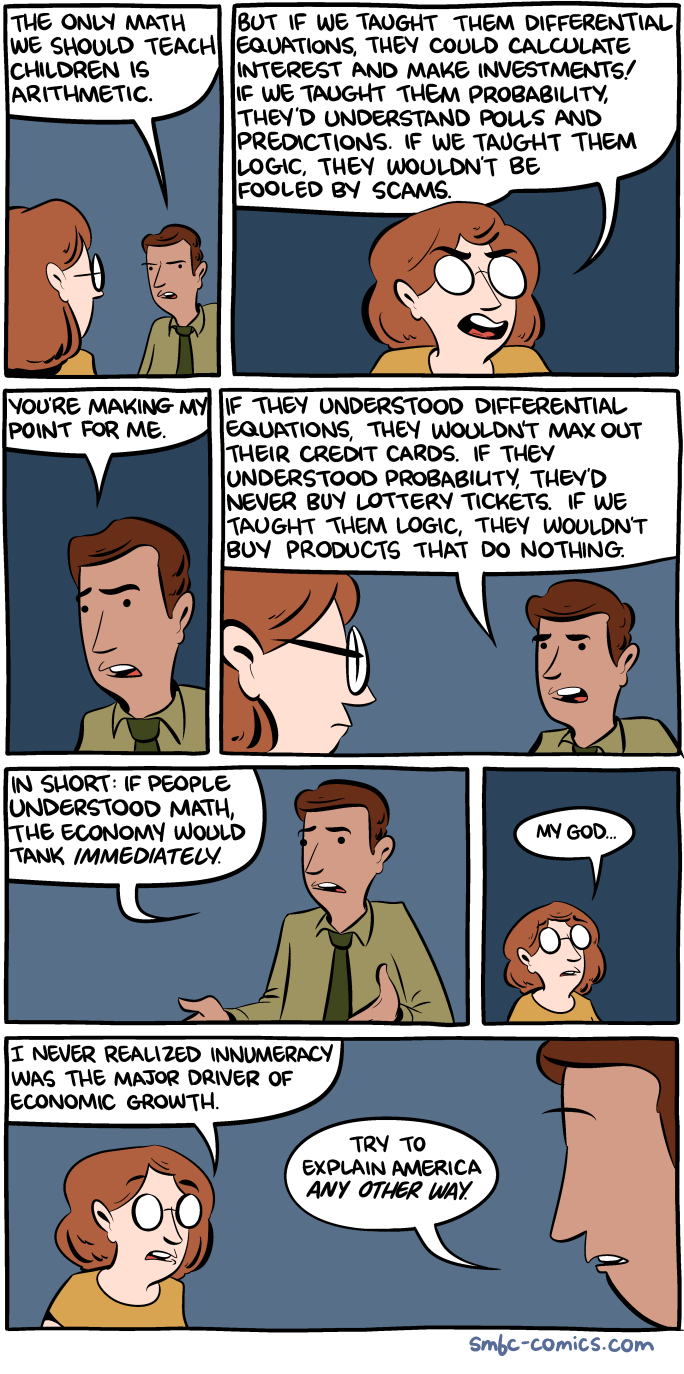
Today's SMBC is very appropriate for this discussion, and it'd be a pity not to include it here:

Until you teach someone calculus, they can't even walk finite distances. But they can get reallllllly close.
-- Source: SMBC, 23.6.2016. (extra panel, off-topic for this discussion, here)

There is also a quote I recently read:

Every maker of video games knows something that the makers of curriculum don't seem to understand. You'll never see a video game being advertised as being easy. Kids who do not like school will tell you it's not because it's too hard. It's because it's boring.
-- Seymour Papert [source]