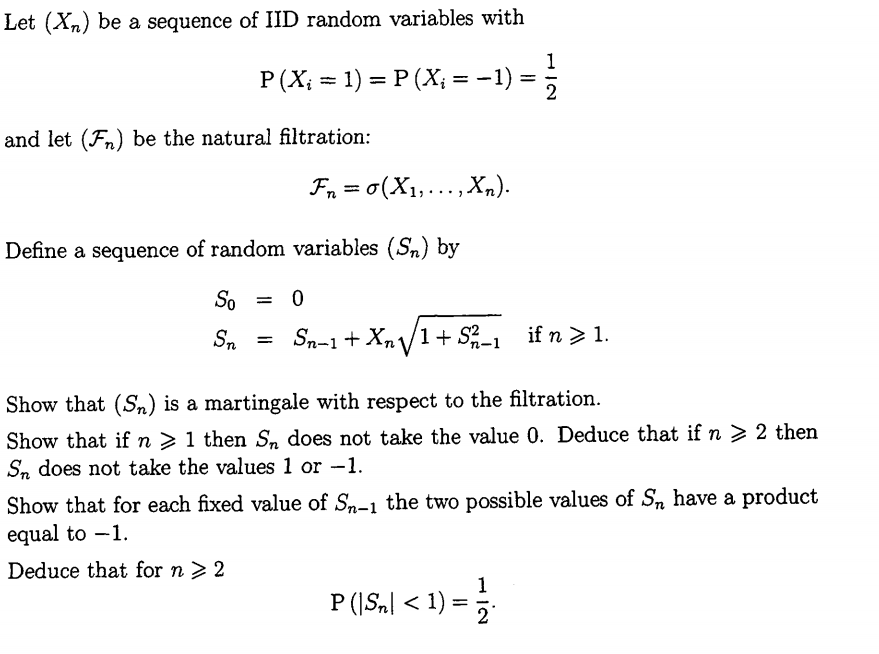
Now, I am stuck on the last part of the question. I managed to find the solutions, but I don't udnerstand them completely.

What I don't understand is: How they got that indicator function, and why they are using double expectation to calculate the probability. I'd appreciate it if someone coudl help out, thanks.

First, we can show the function $f:\mathbb{R}\to \mathbb{R}$ given by $f(x)=\sqrt{1+x^2}$ is such that:
Second, to prove $$ 1_{\{|S_n|<1\}}=\frac{-X_nsign(S_{n-1})+1}{2} $$ note this: \begin{eqnarray} \frac{-X_nsign(S_{n-1})+1}{2} =1 & \iff & -X_nsign(S_{n-1})=1\\ & \iff & (X_n=-1\:\wedge\:S_{n-1}>0)\vee(X_n=1\:\wedge\:S_{n-1}<0)\\ & \implies & |S_n|<1 \end{eqnarray}
(the last line is consequence of the second property of $f(x)$ previously mentioned). On the other hand \begin{eqnarray} \frac{-X_nsign(S_{n-1})+1}{2} =0 & \iff & -X_nsign(S_{n-1})=-1\\ & \iff & (X_n=-1\:\wedge\:S_{n-1}<0)\vee(X_n=1\:\wedge\:S_{n-1}>0)\\ & \implies & |S_n|>1 \end{eqnarray}
(the last line is consequence of the first property of $f(x)$ previously mentioned).
Third, by the previous point $$ \mathbb{P}[|S_n|<1]=\mathbb{E}[1_{\{|S_n|<1\}}]=\mathbb{E}[(-X_nsign(S_{n-1})+1)/2] $$ in other words, computing the desired probability is the same as computing $ \mathbb{E}[(-X_nsign(S_{n-1})+1)/2] $. Computing this directly looks pretty tedius (you'd need to compute the distribution of $X_nsign(S_{n-1})$, etc). Luckily, using the Law of total expectation, the conditional expectation $$ Y_{n-1}:=\mathbb{E}[(-X_nsign(S_{n-1})+1)/2|\mathcal{F}_{n-1}] $$ verifies: $$ \mathbb{E}[(-X_nsign(S_{n-1})+1)/2]=\mathbb{E}[\mathbb{E}[(-X_nsign(S_{n-1})+1)/2|\mathcal{F}_{n-1}]=\mathbb{E}[Y_{n-1}] $$
Hence $$ \mathbb{P}[|S_n|<1]=\mathbb{E}[\mathbb{E}[(-X_nsign(S_{n-1})+1)/2|\mathcal{F}_{n-1}] $$ and since $S_{n-1}\in \mathcal{F}_{n-1}$ and $X_n$ is independent of $\mathcal{F}_{n-1}=\sigma(X_1,...,X_{n-1})$, by properties of conditional expectation we deduce $$ Y_{n-1}=\mathbb{E}[(-X_nsign(S_{n-1})+1)/2|\mathcal{F}_{n-1}]=\frac{\mathbb{E}[X_n]sign(S_{n-1})+1}{2}=\frac{1}{2} $$ hence $$ \mathbb{E}[(-X_nsign(S_{n-1})+1)/2]=\mathbb{E}[Y_{n-1}]=1/2 $$