There are two tests for a disease, one is rapid and the other is slow. Given that an individual is infected, the rapid test will register positive 40% of the time, while the slow test will register positive 80% of the time; additionally, both tests will be positive $35\%$ of the time.
Suppose in the above example that people not infected always test negative for both tests.
Question 1. Assume currently, $20\%$ of the population has the virus. Use Bayes theorem to calculate the chance that a person has the virus conditioned on getting negative results for both tests?
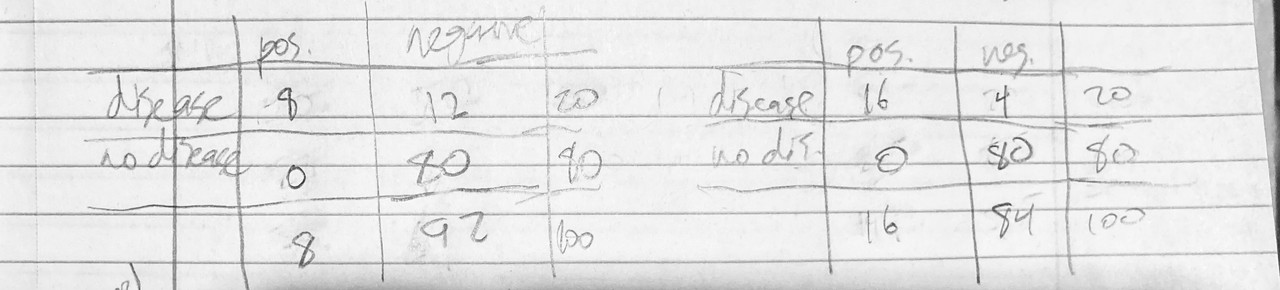
I made this table assuming 100 people tested (rapid test on left; slow on right) to try to calculate this: added 12/92 + 4/84 as those are the people with the disease who tested negative. This answer was incorrect, however.
Question 2 (independent of question 1). Of the people in the population who are tested, 75% of their results from the slow test are positive. What is the chance that a persons has the virus conditioned on getting negative result on the slow test?
For this one, I altered the right table slightly to be 15|4 for the disease column, and did 5/85--also incorrect.