I'm getting some confusion in simplicial homology...Take a very simple example, a (solid) tetrahedron:
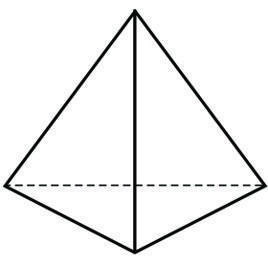
Following the well known property that "the bounday of a boundary is zero", we would end up with $\partial\partial=0$.
Instead, using the "chain complex" concept, the boundary operator seems to map the solid tetrahedron to the "void tetrahedron", and the latter to its edges.
So it seems to me that "taking the boundary" has at leat two different meanings...where am I wrong?

In Homology, we formally add and subtract directed simplices.
0-simplices are the vertices. They have boundary $0$ by definition.
1-simplices are directed segments, so that $BA=-AB$. $\ \partial(AB) =B-A$.
The $n$-simplex $A_1\dots A_n$ is considered to be the same as $A_{\sigma(1)}\dots A_{\sigma(n)}$ if $\sigma$ is an even permutation, and its negative if $\sigma$ is odd.
Define $\partial(A_1\dots A_n) =(A_2\dots A_n)\, - \, (A_1A_3\dots A_n) \, +\, \dots\,\pm\, (A_1\dots A_{n-1})$.
(the $i$th term omits $A_i$, with alternate signs)
Now, in particular for the $ABCD$ simplex, we get $$\partial(ABCD)=BCD - ACD + ABD - ABC\\ \partial(XYZ)=YZ+ZX+XY\\ \partial(\partial(ABCD)) = BC+CD+DB\ - \ AC-CD-DA\ +\ AB+BD+DA\ -\ AB-BC-CA\ =\ 0$$