I was reading a paper which has the following integral in order to do the inverse Laplace transformation:
$$ I=\frac{1}{2\pi i}\int_{-i\infty+\gamma}^{i\infty+\gamma} e^{st}\frac{\Omega^2}{(s^2+4\Omega^2)\sqrt{s^2+4\Delta^2}\sinh^{-1}\frac{s}{2\Delta}}\mathrm{d}s $$
To do this integral, we draw the following contour, in which we can see three poles and two branch points:
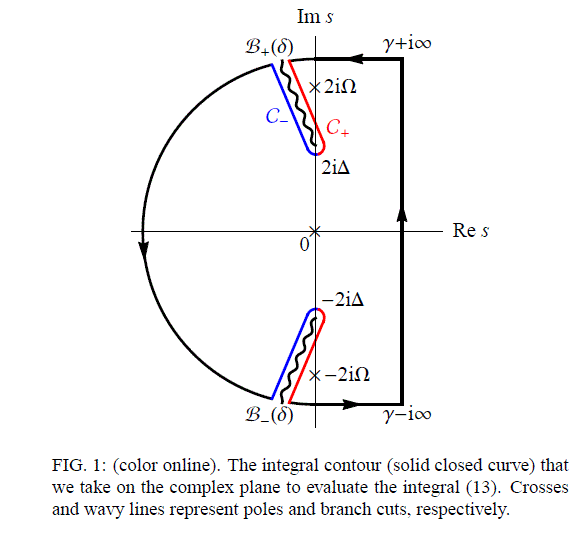
The branch cut is defined as $$\mathcal{B}_{\pm}(\delta)=\{\pm 2i\Delta\pm ir e^{\pm i\delta}|r\in [0,+\infty)\}$$.
My question is, how can I do the blue and red path in large $t$ limit, here is what the paper says:
The asymptotic behavior of the integrals C± for t → ∞ is evaluated by the saddle-point method. Finally we end up with long-time asymptotic forms of the (integral)
I have been working on this integral for two days and learn the very basic knowledge about the stationary point method(the steepest descent method), but still I cannot figure this out.
Please help me with it, thanks in advance.
The answer is as follows, the part with blue lines is the integral along branch cut which I am asking for help.
