Continuous functions which I must lift my pencil to draw

840 Views Asked by At

Am I correct in thinking that the following three functions are continuous?

$$f(x)=\frac{(x-1)(x+2)}{x+2}$$

$$g(x)=\frac{x-1}{x+2}$$

enter image description here

Edit: because of my creativity with the graph, I'm going to have to share its definition for clarity: $$h(x)=\left\{\begin{array} &4.2 &1\leq x<3.75\\ 0.3x+4 & 3.75<x\leq 7 \end{array}\right.$$

2

There are 2 best solutions below

15
On

Those are continuous functions, and that means they are continuous on their domains. However, their domains have limit points to which those functions cannot be extended continuously.

0
On

Yes, all three are continuous functions.

The definition of continuity at a point is based on the fact that the function has a value at that point (if a function is continuous at $x = a$, then $f(a)$ has a value in the expression $|f(x)-f(a)|<\epsilon$). However, it does not make sense to consider points at which a function is not defined. If we were asked to prove that the function is ‘discontinuous’ at a point, we would need to show that the condition for continuity at that point is false. And the negation of the condition for continuity ($\exists\epsilon >0\ \forall \delta>0,\ |x-a|<\delta \text{ and } |f(x)-f(a)|\geq\epsilon$) would not make sense at a point where the function value is not defined. In this way, I think that high school mathematics may often overlook this nuance in the definition of continuity. One usually thinks of continuity in a setting where a function is mapped from a set of real numbers, but let’s quickly extend this idea to a more abstract setting. If $X$ is a metric space, and $b$ is not an element of $X$, then is a function $f:X\to X$, that is otherwise continuous on $X$, discontinuous simply because it is not defined at $b$? One can clearly see the absurdity in this, and in the same way, we should only consider the subset of the real numbers that is the domain of a function when asking questions about continuity. The domains of the first two functions $f$ and $g$ above are $\mathbb R \setminus \{-2\}$.

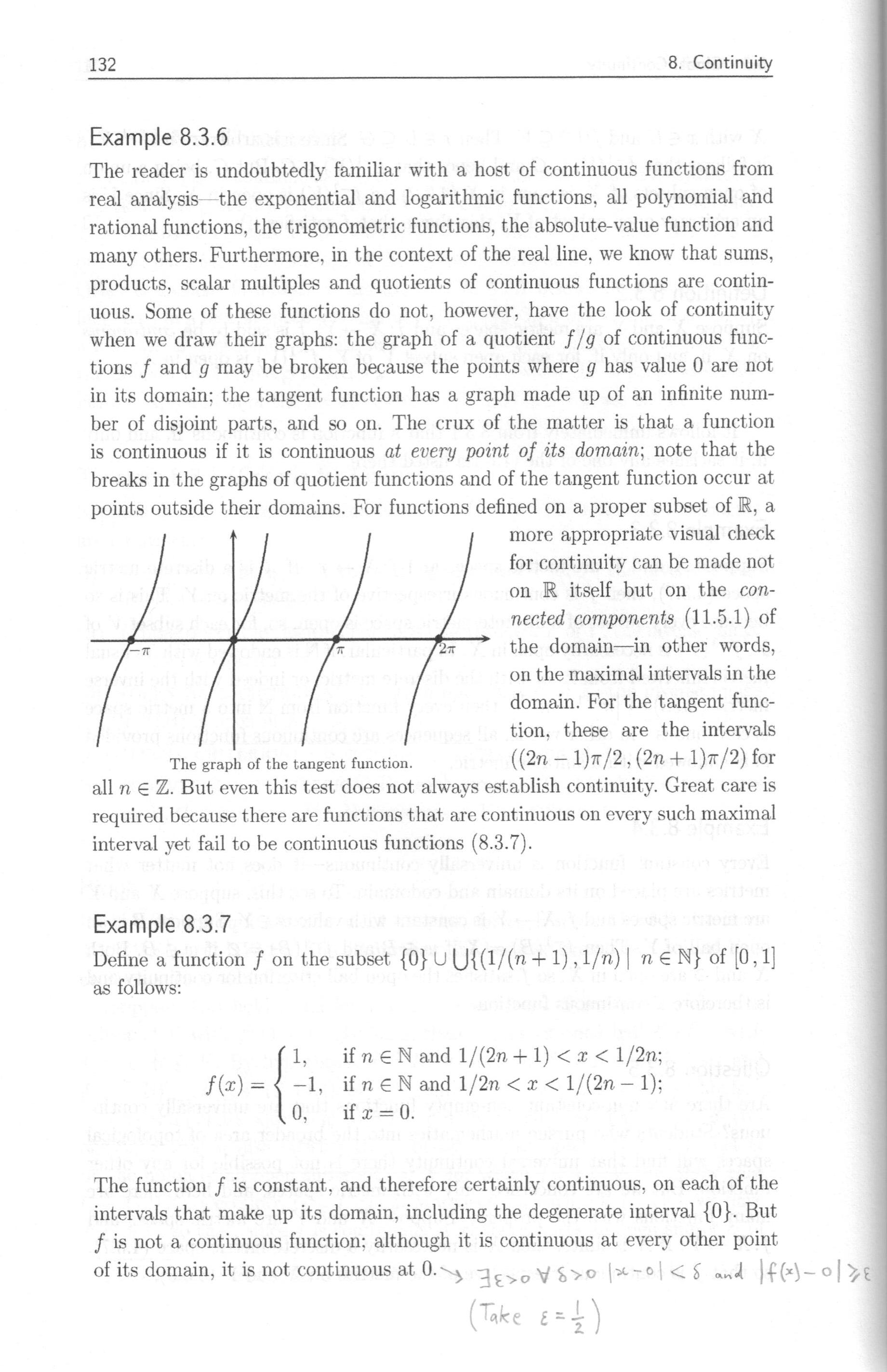
For a textbook reference, see this page from M. Searcóid's textbook Metric Spaces.