I'm trying to solve
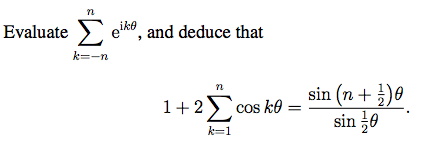
So far I've done the first part, evaluating the summation  ;
;
where a is just n. I'm not sure where to go from here or what it even means deduce the second summation. I understand that the summation of simply $$\sum\limits_{k=0}^n\cos(kx)$$ is derived from looking at the real part of $$\sum_{k=0}^n{\rm e}^{ikx} $$I'm guessing they want me to see how the second summation in the question is defined by 'playing around' with the original?

The first sum you are giving can be written as $$ \sum_{k=-n}^ne^{ik\theta} = \sum_{k=-n}^0e^{ik\theta} + \sum_{k=1}^ne^{ik\theta} = 1+\sum_{k=1}^ne^{-ik\theta} + \sum_{k=1}^ne^{ik\theta} = 1+\sum_{k=1}^n\bigl(e^{ik\theta}+e^{-ik\theta}\bigr) $$ Recall that $\cos(x) = \frac{e^{ix}+e^{-ix}}{2}$ so we have $$ 1+\sum_{k=1}^n\bigl(e^{ik\theta}+e^{-ik\theta}\bigr) = 1 +2\sum_{k=1}^n\cos(k\theta)\tag{1} $$
Let's just focus on the $\sum_{k=1}^n\cos(k\varphi)$ term and consider the series with $+i\sin(k\varphi)$.
\begin{align*} \cos(\varphi) + i\sin(\varphi) + \cdots + \cos(n\varphi) + i\sin(n\varphi) & = e^{i\varphi} + e^{2i\varphi} + \cdots + e^{ni\varphi}\\ & = \sum_{k = 1}^ne^{ki\varphi}\\ & = e^{i\varphi}\frac{1 - e^{i\varphi(n + 1)}}{1 - e^{i\varphi}}\\ & = e^{i\varphi}\frac{e^{i\varphi(n + 1)} - 1}{e^{i\varphi} - 1} \end{align*} Note that $\sin(\frac{\theta}{2}) = \frac{e^{i\theta/2} - e^{-i\theta/2}}{2i}$ so $2ie^{i\theta/2}\sin(\frac{\theta}{2}) = e^{i\theta} - 1$. \begin{align*} \sum_{k = 1}^ne^{ki\varphi} & = e^{i\varphi}\frac{e^{i\varphi(n + 1)/2}\sin\bigl(\frac{\varphi(n + 1)}{2}\bigr)} {e^{i\varphi/2}\sin\bigl(\frac{\varphi}{2}\bigr)}\\ & = \frac{\sin\bigl(\frac{\varphi(n + 1)}{2}\bigr)} {\sin\bigl(\frac{\varphi}{2}\bigr)}e^{in\varphi/2+i\varphi} \end{align*} By taking the real and imaginary parts of, we get the series for $\sum_{k = 1}^n\cos(n\varphi)$ and $\sum_{k = 1}^n\sin(n\varphi)$, respectively. \begin{align*} \sum_{k = 1}^n\cos(k\varphi) & = \frac{\sin\bigl(\frac{\varphi(n + 1)}{2}\bigr)} {\sin\bigl(\frac{\varphi}{2}\bigr)}\cos\Bigl(\frac{(n+1)\varphi}{2}\Bigr)\\ \sum_{k = 1}^n\sin(n\varphi) & = \frac{\sin\bigl(\frac{\varphi(n + 1)}{2}\bigr)} {\sin\bigl(\frac{\varphi}{2}\bigr)}\sin\Bigl(\frac{(n+1)\varphi}{2}\Bigr) \end{align*} Plugging back into $(1)$, we get $$ 1 +2\sum_{k=1}^n\cos(k\theta) = 1 + 2\frac{\sin\bigl(\frac{\varphi(n + 1)}{2}\bigr)} {\sin\bigl(\frac{\varphi}{2}\bigr)}\cos\Bigl(\frac{(n+1)\varphi}{2}\Bigr)\tag{2} $$ By exploiting the identity $\sin(a+b)=\sin(a)\cos(b)+\sin(b)\cos(a)$ in equation $(2)$, we can obtain $$ 1+2\sum_{k=1}^{n}\cos(k\theta) = \frac{\sin[(n+1/2)\varphi]}{\sin(\varphi/2)} $$