In the game Sequence, players hold a hand of cards from a standard 52 card deck. The "board" consists of two decks of cards (sans Jacks) arranged like so:
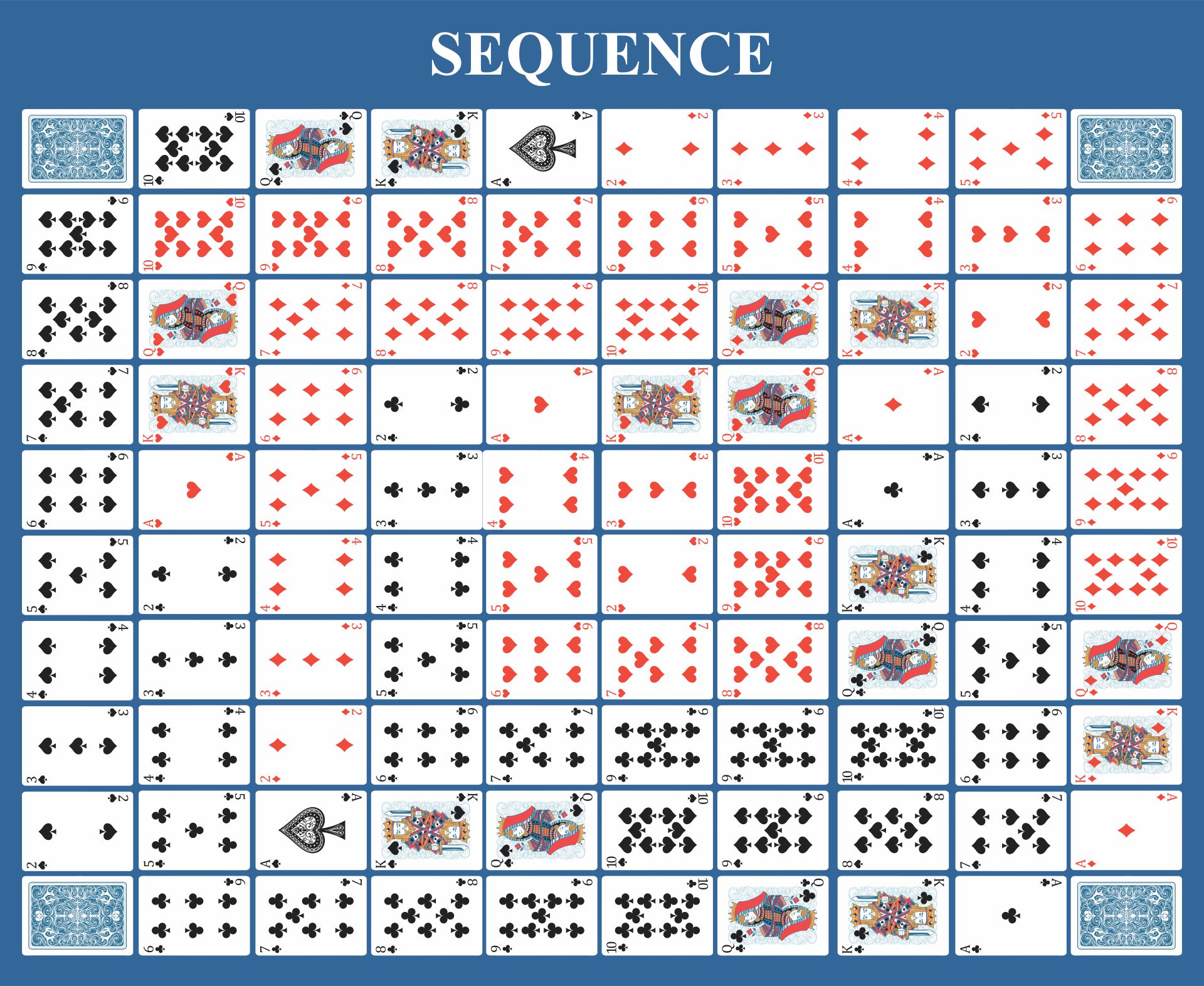
When you play a card from your hand, you place a chip on the corresponding card on the board. The goal is to get five chips in a row, orthogonally or diagonally. Each card appears twice on the board, except the Jack which is used as a wild card.
The arrangement of the cards on the table is striking at first, until you notice they form an inward spiral in order of suit and rank. My question is:
If the arrangement of cards were different on the board, would the game be qualitatively different?
My first assumption was no, because either way, your hand consists of a set of random locations on the board where you may play a chip. If the board itself is randomized on top of that, the locations which you have access to from the cards in your hand are still randomly distributed.
But then, in the course of play, I noticed a feature on this board: in the third from the right column, bottom five rows, there is a sequence of five cards capped on either end by the same card: the King of Clubs. So in order to get that specific sequence, one needs to draw both Kings of Clubs (or one or two Jacks), in addition to the cards in between. And I thought: if the board were randomly reordered, maybe there wouldn't be any sequence of five cards capped on either end by the same card. Then, wouldn't play be qualitatively different in that circumstance?
The draw deck consists of two decks of cards, so each card appears twice (like the board itself). There are therefore only two Kings of Clubs in the deck. In another case, suppose the desired pair was the Ace of Spades and the Five of Diamonds (in the top row). There are two Aces of Spades and two Fives of Diamonds in the deck, so it is therefore slightly more likely (?) to obtain that pair than the pair "two Kings of Clubs".
On the other hand, it may be that (through some pigeonhole/graph coloring type argument) one can say that the event "a sequence of five cards is capped on either end by the same card" actually occurs in every arrangement of the board. In which case, play would not be qualitatively different except for the labelling of the cards in the draw deck/on the board.
I am not sure. I think a more precise question is as follows:
Which events over this board have a probability which is preserved under all rearrangements of the board?
As an example of a nontrivial event which satisfies this property: there are always as many red cards on the left half of the board as there are black cards on the right half, by combinatorics. This aspect of the game is therefore persistent in every arrangement of the board.