I have see a few proofs that, in some systems, a circle with infinite radius is a straight line. A nice example of this is stereographic projection in the complex plane. I have also see simple proofs where people make a circle converge to a vertical line. However this is slightly unsatisfying to me because division by zero is used. Would it be possible to have a circle converge to a non vertical line say: $$1)~~~~~~y = x$$.
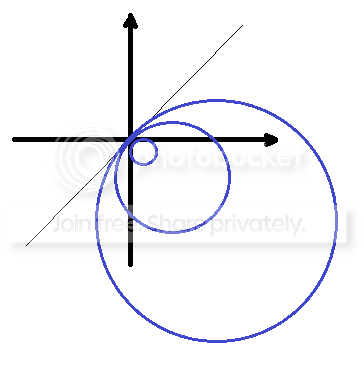
The equation for this should be:
$$ 2)~~~~~~~\lim\limits_{r \to \infty} [ (x - r/\sqrt{2})^2 + (y + r/\sqrt{2})^2 = r^2 ] $$
I am having trouble solving this on my own. So my question is does equation 2 actually converge to equation 1 as $r \to \infty$? Or for that matter is this the right approach for trying to define the line $y = x$ as a circle with infinite radius?

Looking at your equation, when you expand it, you get
$$x^2+y^2-\sqrt{2} rx+\sqrt{2} ry + r^2=r^2$$
Cancelling the $r^2$ and dividing by $\sqrt{2} r$ yields
$$\frac{x^2+y^2}{\sqrt{2} r}-y+x=0$$
which reduces in the limit to $y=x$.