Formula for Overlapping Area of Two Intersecting Circles When Center of One Circle is on Circumference of Other Circle

4.8k Views Asked by At

I know there are already many questions on this site about the area of the overlap between two circles, but I have a special case.

There is one circle with radius 1. There is another circle with unknown radius. The center of the circle with unknown radius is located on the circumference of the circle with radius 1.

Is there a formula to find the area of the overlap between the two circles?

I've tried looking at the generic formulas for area of overlap between two circles, but I've found they don't account for this edge case or they require the same perimeter.

2

There are 2 best solutions below

0
On

Polar integration seems to be the best method for creating a general formula for this.

Re-expressing both circles as polar yields this: $r1 = 1$ and $r2 = cos\theta+\sqrt(a^2-sin^2\theta)$ based off of the general formula for a polar circle, centered at $(1, 0)$ with radius $a$. Really all we need here are the points of intersection which can easily be solved by setting each equation equal and following algebraic and trigonometric rules

$$cos\theta+\sqrt(a^2-sin^2\theta) = 1$$

$$a^2-sin^2\theta=1+cos^2\theta-2cos\theta$$

Replacing $sin^2$ and $cos^2$ with 1 and solving for theta yields:

$$\theta=\pm arcos(a^2-2/-2)$$

From here it should be noted that we must add $\pi$ to the resulting angle because our result accounts for the part of the circle outside of the central unit circle. So our angles from which we base our integral are

$$\theta = \pi \pm arcos(a^2-2/-2)$$

At this point I believe you can evaluate this regularly

$$.5\int_{\theta_1}^{\theta_2} 1^2-[cos\theta+\sqrt({a^2-sin^2\theta})]^2 \,d\theta$$

There may be some errors I missed in my answer however this general method should work

0
On

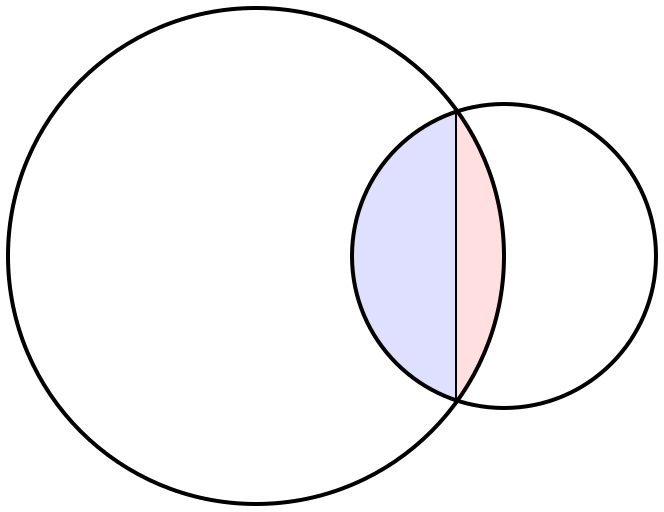
Illustration Without loss of generality, you can choose a coordinate system where the circle with radius $r$ is centered at $(1, 0)$.

If $r \ge 2$, it will cover the entire unit circle, and therefore have the total unit circle area, $\pi$. If $r \gt 1$, we can swap the situation around, simply by replacing $r$ with $1/r$ (scaling the situation by $1/r^2$ along each coordinate axis, so that the larger circle will have radius 1), and scale the result by $r^4$. So, we really only need to look at $0 \le r \le 1$.

We can describe the unit circle as $$y_0(x) = \pm\sqrt{1 - x^2}$$and the smaller circle as $$y_1(x) = \pm\sqrt{r^2 - (x - 1)^2}$$ These intersect at $y_0(x) = y_1(x)$, i.e. at $$\left\lbrace\begin{aligned} x &= 1 - \frac{r^2}{2} \\ y &= \pm\sqrt{r^2 - \frac{r^4}{4}} \\ \end{aligned}\right.$$ Note that the vertical line through the intersections is at $x \le 1$, so for $r \gt 0$, at most half of the $r$-radius circle intersects with the unit circle.

The vertical line through the intersections covers angle $\theta_0$ from the unit circle, $$\theta_0 = 2\arctan\left(\frac{\sqrt{r^2 - \frac{r^4}{4}}}{1 - \frac{r^2}{2}}\right) = 2 \arctan\left(\frac{\sqrt{4 r^2 - r^4}}{2 - r^2}\right) \tag{1}\label{NA1}$$ and angle $\theta_1$ for the other circle (centered at $(1,0)$, $$\theta_1 = 2\arctan\left(\frac{\sqrt{r^2 - \frac{r^4}{4}}}{\frac{r^2}{2}}\right) = 2\arctan\left(\sqrt{\frac{4}{r^2} - 1}\right)\tag{2}\label{NA2}$$

The area of the circular segment of the unit circle that is right of the intersections is $A_0$, $$A_0 = \frac{1}{2}\left(\theta_0 - \sin\theta_0\right) \tag{3}\label{NA3}$$ and the area of the circular segment of the other circle left of the intersections is $A_1$, $$A_1 = \frac{r^2}{2}\left(\theta_1 - \sin\theta_1\right) \tag{3}\label{NA4}$$

The total area $A$, as a function of $r$, is simply the sum of those two circular segments, connected at the vertical line between the two intersection points: $$A = A_0 + A_1 \tag{5}\label{NA5}$$

You can simplify $\sin\theta_0$ to $$\sin\theta_0 = \left(r - \frac{r^3}{2}\right)\sqrt{4 - r^2}$$ and $\sin\theta_1$ to $$\sin\theta_1 = \frac{r}{2}\sqrt{4 - r^2}$$ which gives the entire formula as $$\begin{aligned} A(r) &= \arctan\left(\frac{\sqrt{4 r^2 - r^4}}{2 - r^2}\right) \\ \; &- \left(\frac{r}{2} - \frac{r^3}{4}\right)\sqrt{4 - r^2} \\ \; &+ \arctan\left(\sqrt{\frac{4}{r^2} - 1}\right) \\ \; &- \frac{r}{4}\sqrt{4 - r^2} \\ \end{aligned}$$ i.e. $$A(r) = \arctan\left(\frac{\sqrt{4 r^2 - r^4}}{2 - r^2}\right) + \arctan\left(\sqrt{\frac{4}{r^2} - 1}\right) - \left(\frac{3 r - r^3}{4}\right)\sqrt{4 - r^2} \tag{6}\label{NA6}$$