When proving identities like $$\cosh(2x)=\cosh^2(x)+\sinh^2(x)$$ $$\cosh^2(x)=\sinh^2(x)+1$$ algebraically, I am beset by the feeling that there should be a geometrical interpretation that makes them immediately obvious. Most of the analogous identities involving $\sin,$ $\cos$ have such interpretations.
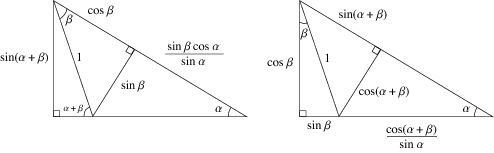
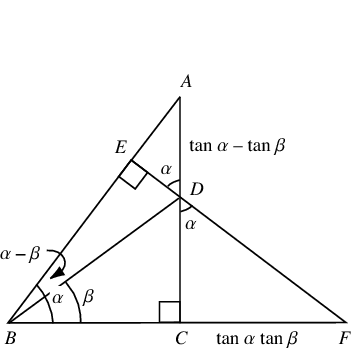
Is it possible to use hyperbolic geometry to prove identities in hyperbolic trigonometry geometrically? Any examples would be greatly appreciated (if this is in fact possible).
Addendum: If there is no analogy in hyperbolic trigonometry, could the complex plane and the relationship between hyperbolic and non-hyperbolic functions be used instead (i.e. $\cos(x)= \cosh(ix), \sin(x)=-i\sinh(ix))$?
The second identity is equivalent to saying that for all $x\in\mathbb{R}$ there is a triangle with hypotenuse $\cosh(x)$ and sides $\sinh(x),1$. Is there a geometric interpretation of $x$?