Apologies for a crude drawing, but let's say we have a figure:
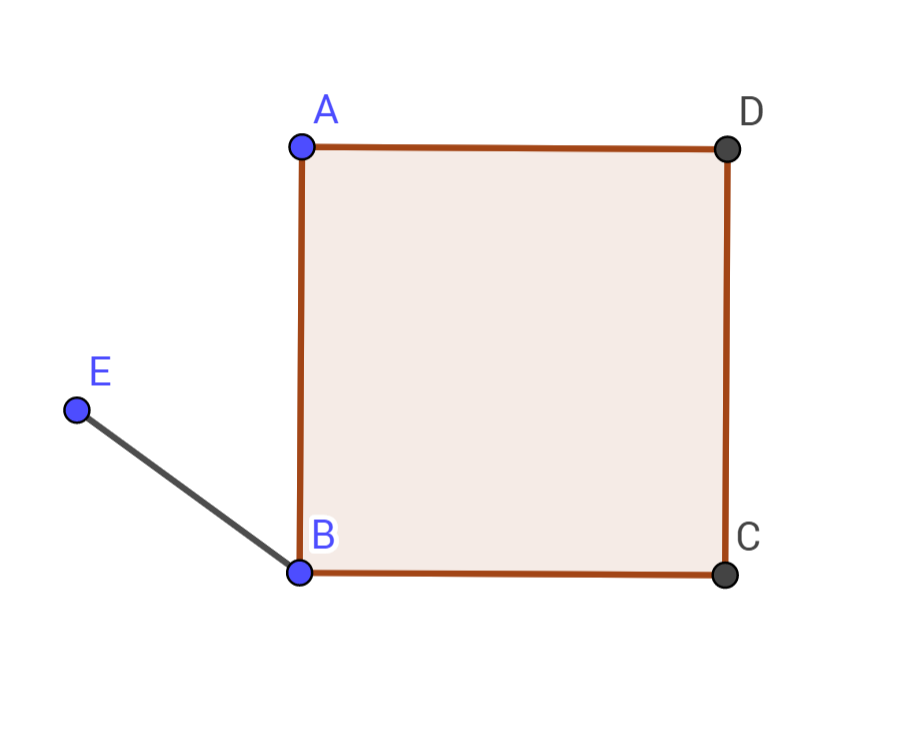
Where the square has the points $B(0,0)$, $A(1,0)$, $D(1,1)$, $C(0,1)$, the length of $EB$ is $\frac{1}{\sqrt{2}}$. How can we prove that if we draw a ray from $E$ parallel to $BD$ (the diagnal of the square) it will intersect $A$?
It seems intuitively obvious to me but I do not understand how to make the proof. Thank you.
EDIT: One of the given things was not actually given, I assumed it incorrectly. I apologize. I've removed it.

Clearly, $|EA| = \frac{1}{\sqrt{2}}$ so $\Delta AEB$ is an isosceles right angle triangle. So $\angle EAB = 45^\circ$. Since $\angle EAB = \angle ABD$, we can conclude that $AE // BD$.