I am interested in getting a (continuous) approximation for the equipotential lines of the function $$f(L,\Delta)=2^{-L}\binom{L}{\frac{L-\Delta}{2}}$$
So I tried to solve $const.=f(L,\Delta)$ for either $L$ or $\Delta$ using factorials for the binomial coefficient and then Stirling's formula for the factorials. But that leads to an equation that has terms of the form $(L-\Delta)^{L-\Delta}$ (or similar) and I don't know how to solve that for either $L$ or $\Delta$.
The equipotential lines look roughly like the silhouette of on egg. I was hoping that if I find an approximation of the binomial coefficient that is crude enough, I could derive an approximation for the equipotential lines in the form of (perhaps) an ellipse $\frac{L^2}{a^2}+\frac{\Delta^2}{b^2}=const.$
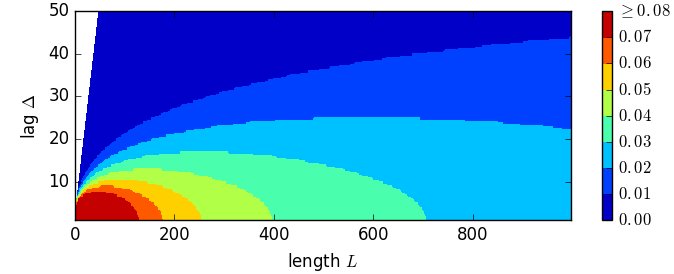
EDIT
Claude Leibovici suggested an approach to approximating $f$ (see his answer below). I used his $O(\frac{1}{L})^5$ equation to get an approximation for equipotential lines of $f$.
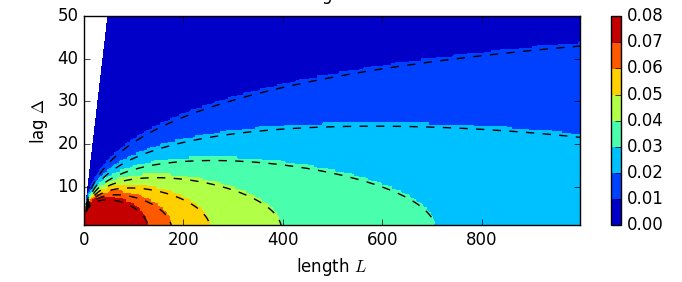
Here, the dashed lines are results of Claude's approximation.
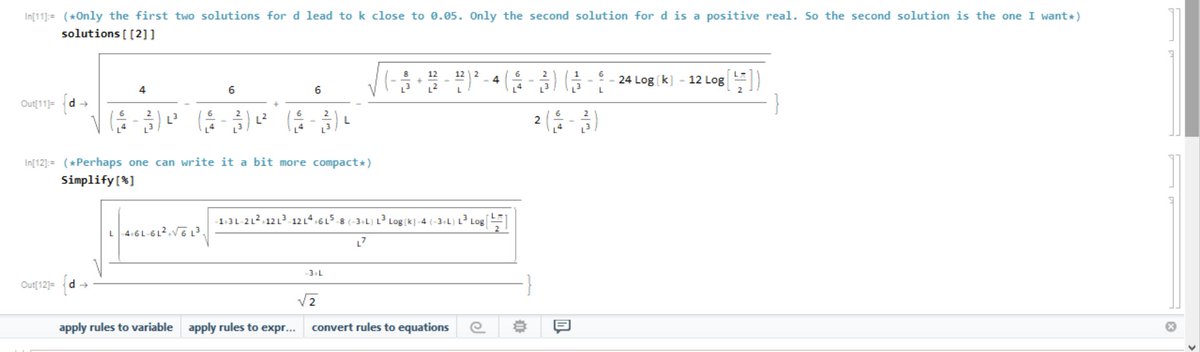
In case somebody is interested in reproducing this, here is my mathematica notebook:


If you want to solve for $\Delta$ the equation$$2^{-L}\binom{L}{\frac{L-\Delta}{2}}=\frac{2^{-L}\,\,L!}{\left(\frac{L-\Delta }{2}\right)!\,\, \left(\frac{L+\Delta }{2}\right)!}=k$$ take logarithms of both sides and, for each factorial, use Stirling approximation for large values of $L$ and continue expanding the result using Taylor expansions still for infinitely large values of $L$.
This would lead to $$\log \left(2^{-L} \binom{L}{\frac{L-\Delta }{2}}\right)=\frac{1}{2} \log \left(\frac{2}{\pi L}\right)-\frac{2 \Delta ^2+1}{4 L}+\frac{\Delta ^2}{2 L^2}-\frac{2 \Delta ^4+8 \Delta ^2-1}{24 L^3}+\frac{\Delta ^4}{4 L^4}+O\left(\frac{1}{L^5}\right)$$ which is a quadratic polynomial in $\Delta^2$. If you truncate to $O\left(\frac{1}{L^3}\right)$, the solution is immediate. For more accuracy, just continue the expansions to get cubic, quartic, quintic, sextic, $\cdots$, polynomials in $\Delta^2$.
For example, using $L=100$ and $k=0.05$ in the complete expansion given above, this would lead to $\Delta=9.683$ while the exact solution would be ... the same !
You need to play with it and see how good or bad this could be.
On my side, I made a contour plot and it seems to be quite good.
Assuming that you will not plan to go beyound $O\left(\frac{1}{L^5}\right)$, we can simplify using Padé approximants and write $$-\frac{2 \Delta ^2+1}{4 L}+\frac{\Delta ^2}{2 L^2}-\frac{2 \Delta ^4+8 \Delta ^2-1}{24 L^3}+\frac{\Delta ^4}{4 L^4}=\frac{\alpha+\beta\, \Delta^2} {1+\gamma\,\Delta^2}$$ where $$\alpha=\frac{1-6 L^2}{24 L^3}\qquad \beta=\frac{-24 L^5+48 L^4-54 L^3+26 L^2-11 L+1}{16 L^4 \left(3 L^2-3 L+2\right)}\qquad \gamma=\frac{3-L}{2 L \left(3 L^2-3 L+2\right)}$$ which let us with the simple linear equation in $\Delta ^2$ $$\color{blue}{\frac{\alpha+\beta\, \Delta^2} {1+\gamma\,\Delta^2}=\frac{1}{2} \log \left(\frac{\pi L k^2 }{2} \right)}$$
Edit
I produced a table of $\log(k)$ computed using the above expansion as well as with the original equation. $$\left( \begin{array}{cccc} L & \Delta & \text{approximation} & \text{exact} \\ 100 & 0 & -2.53088 & -2.53088 \\ 100 & 10 & -3.02672 & -3.02672 \\ 100 & 20 & -4.52394 & -4.52416 \\ 100 & 30 & -7.05165 & -7.05410 \\ 100 & 40 & -10.6583 & -10.6726 \\ 100 & 50 & -15.4119 & -15.4693 \\ & & & \\ 200 & 0 & -2.87620 & -2.87620 \\ 200 & 10 & -3.12506 & -3.12506 \\ 200 & 20 & -3.87286 & -3.87287 \\ 200 & 30 & -5.12330 & -5.12337 \\ 200 & 40 & -6.88253 & -6.88296 \\ 200 & 50 & -9.15918 & -9.16083 \\ & & & \\ 300 & 0 & -3.07852 & -3.07852 \\ 300 & 10 & -3.24466 & -3.24466 \\ 300 & 20 & -3.74345 & -3.74346 \\ 300 & 30 & -4.57600 & -4.57601 \\ 300 & 40 & -5.74414 & -5.74419 \\ 300 & 50 & -7.25042 & -7.25064 \\ & & & \\ 400 & 0 & -3.22215 & -3.22215 \\ 400 & 10 & -3.34685 & -3.34685 \\ 400 & 20 & -3.72111 & -3.72111 \\ 400 & 30 & -4.34539 & -4.34539 \\ 400 & 40 & -5.22047 & -5.22048 \\ 400 & 50 & -6.34743 & -6.34748 \\ & & & \\ 500 & 0 & -3.33360 & -3.33360 \\ 500 & 10 & -3.43340 & -3.43340 \\ 500 & 20 & -3.73290 & -3.73290 \\ 500 & 30 & -4.23233 & -4.23234 \\ 500 & 40 & -4.93210 & -4.93210 \\ 500 & 50 & -5.83274 & -5.83276 \\ & & & \\ 600 & 0 & -3.42467 & -3.42467 \\ 600 & 10 & -3.50787 & -3.50787 \\ 600 & 20 & -3.75751 & -3.75751 \\ 600 & 30 & -4.17374 & -4.17374 \\ 600 & 40 & -4.75677 & -4.75677 \\ 600 & 50 & -5.50694 & -5.50694 \\ & & & \\ 700 & 0 & -3.50169 & -3.50169 \\ 700 & 10 & -3.57302 & -3.57302 \\ 700 & 20 & -3.78703 & -3.78703 \\ 700 & 30 & -4.14382 & -4.14382 \\ 700 & 40 & -4.64353 & -4.64353 \\ 700 & 50 & -5.28637 & -5.28637 \\ & & & \\ 800 & 0 & -3.56841 & -3.56841 \\ 800 & 10 & -3.63083 & -3.63083 \\ 800 & 20 & -3.81812 & -3.81812 \\ 800 & 30 & -4.13034 & -4.13034 \\ 800 & 40 & -4.56758 & -4.56758 \\ 800 & 50 & -5.12997 & -5.12997 \\ & & & \\ 900 & 0 & -3.62727 & -3.62727 \\ 900 & 10 & -3.68276 & -3.68276 \\ 900 & 20 & -3.84926 & -3.84926 \\ 900 & 30 & -4.12680 & -4.12680 \\ 900 & 40 & -4.51546 & -4.51546 \\ 900 & 50 & -5.01533 & -5.01533 \\ & & & \\ 1000 & 0 & -3.67992 & -3.67992 \\ 1000 & 10 & -3.72987 & -3.72987 \\ 1000 & 20 & -3.87973 & -3.87973 \\ 1000 & 30 & -4.12954 & -4.12954 \\ 1000 & 40 & -4.47933 & -4.47933 \\ 1000 & 50 & -4.92919 & -4.92919 \end{array} \right)$$ This looks to be very promising.
If you want a larger expansion, you could get $$\log \left(2^{-L} \binom{L}{\frac{L-\Delta }{2}}\right)=\frac{1}{2} \log \left(\frac{2}{\pi L}\right)-\frac{2 \Delta ^2+1}{4 L}+\frac{\Delta ^2}{2 L^2}-\frac{2 \Delta ^4+8 \Delta ^2-1}{24 L^3}+\frac{\Delta ^4}{4 L^4}-\frac{2 \Delta ^6+20 \Delta ^4-16 \Delta ^2+3}{60 L^5}+\frac{\Delta ^6}{6 L^6}-\frac{6 \Delta ^8+112 \Delta ^6-224 \Delta ^4+256 \Delta ^2-51}{336L^7}+\frac{\Delta ^8}{8 L^8}-\frac{2 \Delta ^{10}+60 \Delta ^8-224 \Delta ^6+640 \Delta ^4-768 \Delta ^2+155}{189L^9}+\frac{\Delta ^{10}}{10 L^{10}}+O\left(\frac{1}{L^{11}}\right)$$