How do I calculate the area of a curved irregular plane such as an aeroplane wing?

1.2k Views Asked by At

So I need to calculate the wing area of an airbus a350 and all I have is this blueprints. Thought about searching functions that fit the wing from the top perspective and then integrate, but I dont know how to consider the curvature of the wing. These are the resources that I plan to use:

https://upload.wikimedia.org/wikipedia/commons/9/92/A32XFAMILYv1.0.png

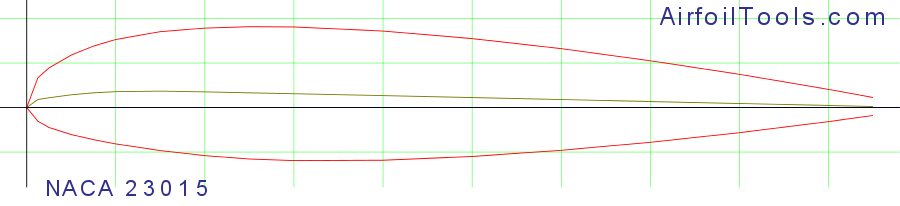
http://airfoiltools.com/images/airfoil/naca23015-il_l.png

2

There are 2 best solutions below

0
On

First you want to get the planform area. You can do that by superposing a grid on the wing and counting squares or by breaking it into simple shapes. I suspect the wing is very close to an irregular quadrilateral, so just draw a diagonal and find the area of each triangle.

Assuming the airfoil is the same in every line parallel to the longitudinal axis you now need to find how much longer the top and bottom curves are than the straight line through the wing. You can just draw it and measure a piecewise linear approximation, or lay a piece of string along it and measure the string. The surface area will be greater than the planform area by the factor of the string length to the straight line length. You get a different factor for top and bottom.

0
On

Just for completeness (in case someone really wants the outer surface area of the three-dimensional wing), the Web page http://airfoiltools.com/airfoil/details?airfoil=naca23015-il cited in the question also contains a list of data points giving coordinates of several points along the top and bottom of the wing section.

You can put those coordinates in an electronic spreadsheet and use the formula $d = \sqrt{(x_1 - x_2)^2 + (y_1 - y_2)^2}$ to calculate the distance between each consecutive pair of points along the top of the profile, and also along the bottom. Take the sum of all these point-to-point distances; this will give you an approximation of the total length of the curve. (It will be only very slightly less than the true value due to the curvature of the surface between points--emphasis on very slightly.)

Divide by the distance from the leftmost point to the rightmost point, and this will give you the ratio of curve length to chord length; this will be a number a little greater than $2$ and will be very nearly the same as the ratio of surface area to planform area. (You may want to divide by the cosine of the dihedral angle as well to account for the fact that the wings are mounted at an angle from horizontal.)

The planform area can be estimated by treating each wing as a pair of connected trapezoids in the planforms you have, or you can just look up the wing area. The site flugzeuginfo.net/acdata_php/acdata_a320_en.php gives 122.6 square meters for an Airbus A320.

Warning: The surface area calculated this way is not useful in the usual calculations of aerodynamic forces, which are based on the planform area instead. The difficult part of the calculation of forces is finding the coefficients of lift and drag: these can be estimated through a sophisticated integral of the theoretical air circulation around the wing (which does require a model of the wing's cross-section), but accurate formulas for the coefficients at each angle of attack can only be found by empirical testing. Those formulas are trade secrets.