In the real number system,the equation $\sqrt{x+3-4\sqrt{x-1}}+\sqrt{x+8-6\sqrt{x-1}}=1$ has how many solutions?
I tried shifting the second term to the rhs and squaring.Even after that i'm left with square roots.No idea how to proceed.Help!
In the real number system,the equation $\sqrt{x+3-4\sqrt{x-1}}+\sqrt{x+8-6\sqrt{x-1}}=1$ has how many solutions?
I tried shifting the second term to the rhs and squaring.Even after that i'm left with square roots.No idea how to proceed.Help!
 On
On
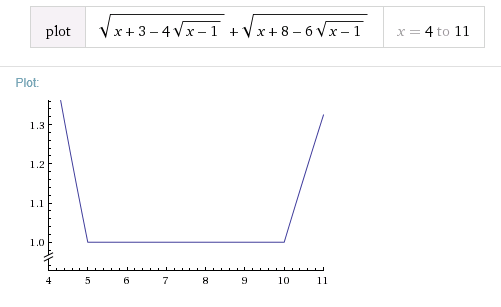
I found that to be odd. So the solutions are $x \in [5,10]$. I guess it wouldn't be too hard to formally prove that.
Hint: the imaginary parts cancel on this interval.
On
Set $x=z^2+1$. Then: $$ \sqrt{x+3-4\sqrt{x-1}}+\sqrt{x+3-8\sqrt{x-1}} = \sqrt{(z-2)^2}+\sqrt{(z-3)^2} = |z-2|+|z-3| $$ equals one for every $z\in[2,3]$, hence for every $x\in[5,10]$.
On
\begin{align} &\sqrt{x+3-4\sqrt{x-1}}+\sqrt{x+8-6\sqrt{x-1}} = 1\\ \implies &\sqrt{(x-1)-4\sqrt{x-1} + 4}+\sqrt{(x-1)-6\sqrt{x-1}+9}=1\\ \implies &\sqrt{(\sqrt{x-1}-2)^2}+\sqrt{(\sqrt{x-1}-3)^2}=1\\ \implies &|\sqrt{x-1}-2| + |\sqrt{x-1}-3| = 1\tag{1} \end{align}
This calls for casework:
1. $\quad\sqrt{x-1}\geq 3$
$(1)\implies \sqrt{x-1}-2 + \sqrt{x-1}-3 = 1\implies \sqrt{x-1} = 3\implies x=10$
2. $\quad 2\leq\sqrt{x-1} < 3$
$(1)\implies \sqrt{x-1}-2 - \sqrt{x-1}+3 = 1\implies 1 = 1$ and thus all $x$ such that $2\leq\sqrt{x-1} < 3$, i.e. $x\in [5,10\rangle$
3. $\sqrt{x-1} < 2$
$(1)\implies -\sqrt{x-1}+2 - \sqrt{x-1}+3 = 1\implies \sqrt{x-1} = 2 \implies x = 5$, but this $x$ doesn't satisfy our condition 3 (although it does satisfy condition 2, and is already included as a solution)
Taking union, we conclude that any $x\in[5,10]$ is a solution to the equation.
On
$$x+3-4\sqrt{x-1}=x-1+4-4\sqrt{x-1}=(x-1)-4\sqrt{x-1}+4=(\sqrt{x-1}-2)^2$$ Similarly $$x+8-6\sqrt{x-1}=(\sqrt{x-1}-3)^2$$ from which the answer.
It is not an equation but an identity in its domain of definition.This is the reason there are infinitely many solutions and not the expected finite number of them of a true equation with coefficients in a field. For example the "equation"
$$\sqrt[3]\frac{x^3-3x+(x^2-1)\sqrt{x^2-4}}{2}+\sqrt[3]\frac{x^3-3x-(x^2-1)\sqrt{x^2-4}}{2}=x$$ has all the reals as solutions.
Hint:
Notice that $$x+3-4\sqrt{x-1}=x-1-4\sqrt{x-1}+4=(\sqrt{x-1}-2)^2$$
and
$$x+8-6\sqrt{x-1}=x-1-6\sqrt{x-1}+9=(\sqrt{x-1}-3)^2=(3-\sqrt{x-1})^2$$
After, you can try by cases.