I’m an amateur naturalist and am fascinated with the underlying geometry of an insect eye primarily made of hexagonal facets. In particular, how the sphere surface is fully packed as the hexagons become small with respect to the sphere radius.
When the hexagon is large relative to the sphere radius, such as a soccer ball, it is a truncated icosahedron with 12 pentagons and 20 hexagons.
As the hexagons decrease in size is there a fixed relation between the number of pentagons required and are they still evenly distributed in some pattern?
As the hexagons get progressively smaller, is it true to say that the hexagon becomes flatter on the sphere surface and as hexagons can fully pack a plane, does this suggest that at the limit, hexagons alone can fully pack a sphere surface?
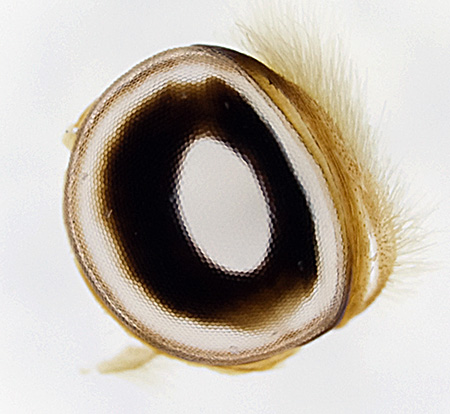
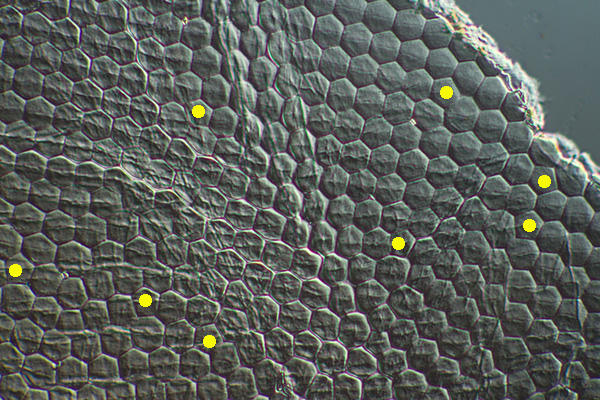
From my own study of the cornea of a cultivated silk moth eye, the eye diameter is ca. 1.4 mm and the width of each facet across flats is ca. 0.0256 mm (includes wall thickness). But there are a noticeable number of pentagons scattered across the surface, a selection marked with a yellow dot in the image I took below. They seem rather randomly distributed though and wasn’t sure if this was Mother Nature getting a hexagonal facet wrong occasionally or that she can’t bypass geometry and still needs to add some pentagons.
If estimating the number of facets on the eye is dividing the hexagonal area (including wall thickness) into the sphere area as good a way as any? In this case gives 7233 for both eyes combined as each silk moth eye is only 2/3rds of a hemisphere.
Thanks for any insight!

If you cover a sphere with pentagons and hexagons, you need exactly $12$ pentagons, no matter what the number of hexagons. This comes from the Euler characteristic, which says $V-E+F=2$ with $V$ the number of vertices, $E$ the number of edges, and $F$ the number of faces. We have three faces meeting at each vertex.If we have $p$ pentagons and $h$ hexagons, there are $5p+6h$ corners of faces, so $\frac 13(5p+6h)$ vertices, $\frac 12(5p+6h)$ edges, and $p+h$ faces. Put this all together and we have $$\frac 13(5p+6h)-\frac 12(5p+6h)+(p+h)=2\\ \frac 53p+\frac 63h-\frac 52p-\frac 62h+p+h=2\\\frac 16p=2\\p=12$$