In mathpages, "On the Ellipse", the author starts, as usual, by considering an intersection of a plane and a cone. But, in order to derive further properties of the ellipse, he immediately states after that
By symmetry, the locus of intersection between the cone and the plane is also the locus of intersection of two right cones with parallel axes offset from each other, as shown in the figure below.
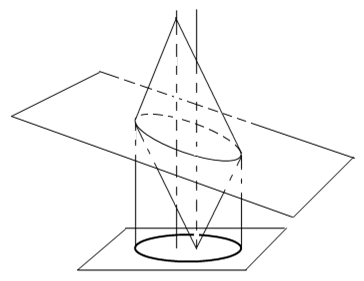
Why should this be the case, a-priori? Is there any reason to think, without any derivations\algebra, that it should be symmetric about this axis? Or vice versa, that the intersections of two right cones with parallel axes should be planar - without any proof or calculations?
The author doesn't regard this point anywhere in this page.
Any help is appreciated.

Look from the front so the picture is in 2D.
Imagine translating each of the two edges of down-cone, so that they connect with the edge's intersection with the vertical side of the cylinder. This way you constructed a parallelogram. Therefore, you see the angle of the up-cone and the down-cone (in 3D, solid angle) must be equal - that they are really from the same cone. Now the symmetry about the axis is simple from trigonometry.