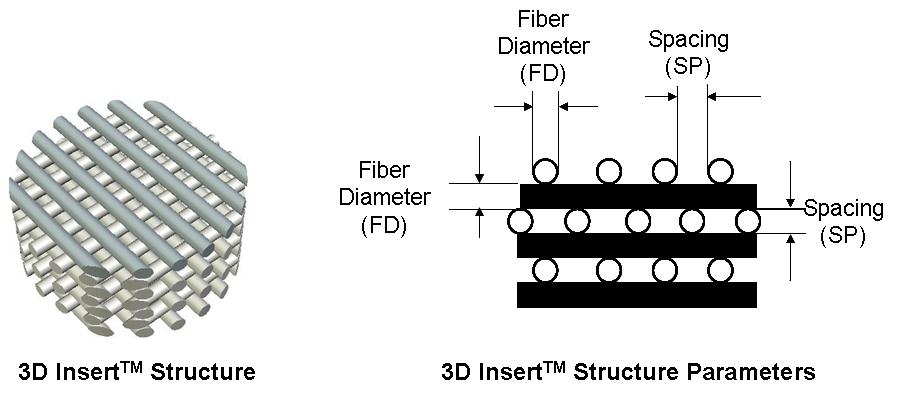
I'm trying to calculate the correct distance to achieve a certain porosity in a 3D printed scaffold. The scaffold is circular with fixed distances between lines of printed material, with alternating horizontal and vertical lines.
So it boils down to having a circle with known radius (5mm) and equally spaced parallel chords with a known total length (240.4851mm). The best I can figure, the system describes a series of equations of the form: R^2=(AB)^2+L^2; where r is the radius, B is the line spacing constant, A is the integer which increases by one for each chord, and l is half the length of the chord. The sum of every l=240.481 and A goes 1,2,3,4...to some value that such that AB<10 (diameter). Here's a link to an image which may clarify the problem: http://www.3dbiotekstore.com/images/3D_insert_structure2.jpg.
Any help or hints for a biologist out of his element? How would I go about calculating B?

This must be computed numerically. It is not clear from your question if the total length is $240.4851$ or $240.481$. Assuming it is the latter, then it turns out that you need $30$ chords and $$ B=0.325398. $$