I don't have a large mathematical background, but I'm working with Computational Neuroscience. I have a large Synaptic Matrix (x axis: presynaptic NeuronID, y axis: postsynaptic NeuronID) in a Modular network. This matrix is close to a random one and Girko's circular law applies partly, in the sense that the bulk of the eigenvalues lies in a circle when you plot their Imag/Real parts; some eigenvalues will be outside the bulk because of the network's modularity (1).
Moreover, my system is nonlinear since it is composed of neurons, whose population activity's transfer function is close to a sigmoid (2).
Can I derive some conclusions about my system's stability (locally at least) based on the eigenvalues? For instance, if I have a large real eigenvalue, my system could prove to be unstable, with exponentially increased activity over time..

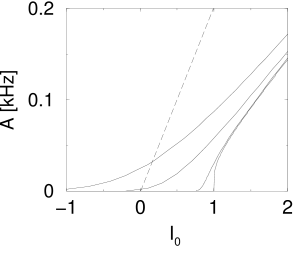
Linear stability analysis for a discrete dynamical system only make sense close to an equilibrium whose e.v. are all strictly inside the unit ball (have negative real parts) as pointed out CTNT.
In general usually for highly nonlinear systems like yours stability analysis via linearisation does not work. If you have eigenvalues with modulus very close to $1$ (real part close to $0$ in continuous case) you might expect some periodicity to occur in your system.
If you really expect very strong stability (that every solution in the interesting set converges to a particular equilibrium) you might try to construct a Lyapunov function. Whether it is possible to do for large systems of interacting neurons -- I have no idea.
Numerically people often compute Lyapunov exponents -- if all of them are less ore equal than zero, the system is considered stable. But this is not rigorous in any sense.