While shaving my beard over the bathroom sink, I glumly noticed a broken sinkhole plug lifting mechanism. Instead of being fully raised, it budges only a bit. As a result, the water discharge is rather mediocre.
I have recently read an article on Better Explained explaining exponential growth. Watching the contour of the water's surface leisurely contract, I attempted to find an exercise which would include that growth in the answer.
Given a spherical sink, how quickly does the surface's circumference change compared to the change in its height (i.e., the distance from the surface to the sinkhole)?
Later, after a short calculation, I arrived at a result:
$$\frac{dCircumference}{dh} = \pi cos(\frac{h}{H}\frac{\pi}{2})$$
where h is the current sink depth, whereas H is the maximum sink depth.
Despite apparently solving the exercise, I was dissapointed to see that I stated the wrong problem - the solution does not contain e.
How can one refactor the problem into one that includes it? I would imagine that the question would have to include a unit of time, for example:
Given a spherical sink of radius R filled with water with a starting depth of H, from which water flows out at a rate proportional/related to current depth, what amount of time is needed for the depth to be reduced to 25% of its starting value?

From the way you posed the problem, we are looking to solve for $h(t)$, the height of the water at time $t$. We know $h(0)=H$, since initially it is at its maximum height. We also have that $$\frac{dV}{dt}=ch$$ from the statement that we have proportionality between the rate and the current value of $h$. Thus, proposing this as initial value problem gives us: $$\frac{dV}{dt}=ch \text{,}\hspace{3mm} h(0)=H.$$ Now looking at the equation the volume of a spherical cap, $$V=\frac{\pi(3a^2h+h^3)}{6}$$ and $$a=\sqrt{R^2-(R-h)^2}=\sqrt{2Rh-h^2}$$where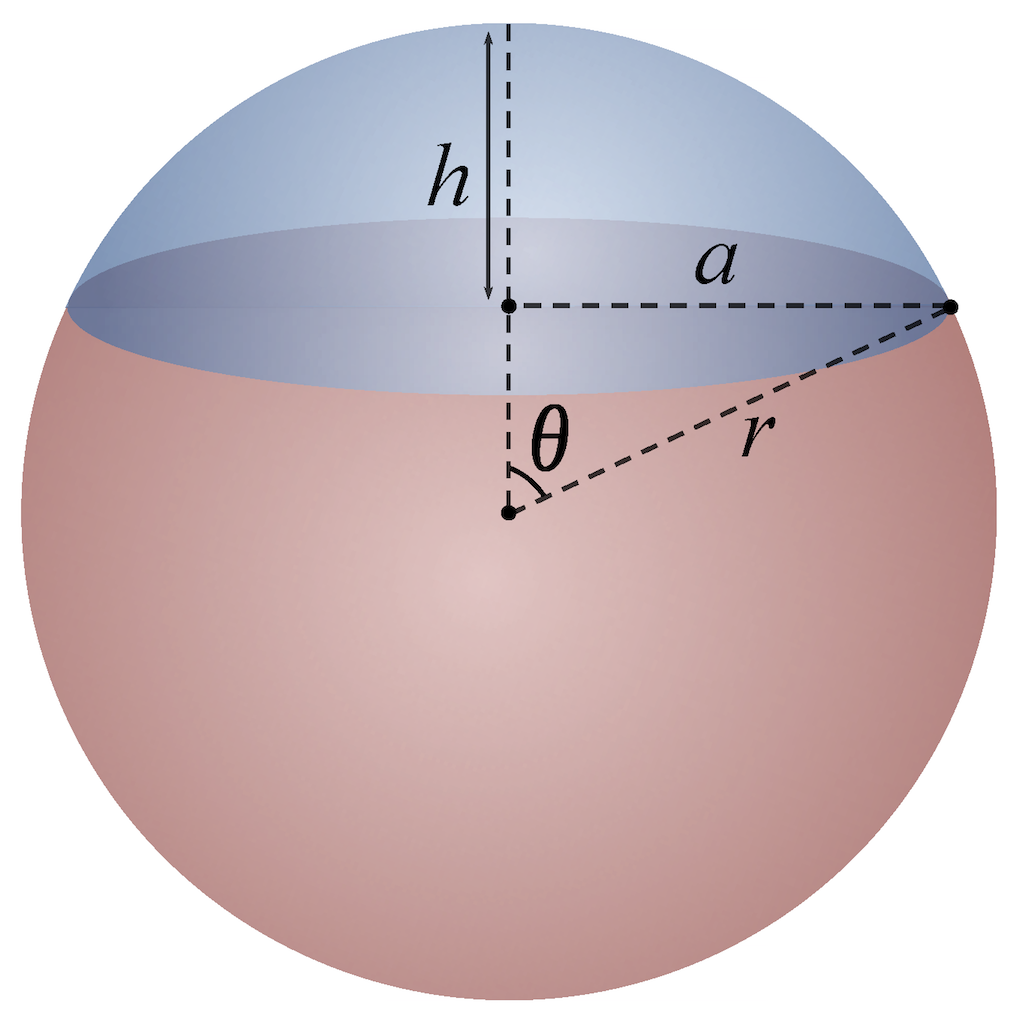 (Image from https://en.wikipedia.org/wiki/Spherical_cap)

Using implicit differentiation, we arrive at $$\frac{dV}{dt}=ch=\frac{\pi}{6}\Big(6ah\frac{da}{dt}+3a^2\frac{dh}{dt}+3h^2\frac{dh}{dt}\Big)$$ $$\frac{da}{dt}=\frac{2R\frac{dh}{dt}-2h\frac{dh}{dt}}{2\sqrt{2Rh-h^2}}.$$ Assuming that $h$ is not $0$, we can multiply the change in volume equation by $\frac{6}{\pi h}$ and get $$\frac{6c}{\pi}=6\frac{a}{h}\frac{da}{dt}+3\frac{a^2}{h}\frac{dh}{dt}+3h\frac{dh}{dt}.$$ Defining $d=\frac{6c}{\pi}$ and substituting for $a$ and $\frac{da}{dt}$ we end up getting $$d=6\frac{\sqrt{2Rh-h^2}}{h}\frac{2R\frac{dh}{dt}-2h\frac{dh}{dt}}{2\sqrt{2Rh-h^2}}+3\frac{2Rh-h^2}{h}\frac{dh}{dt}+3h\frac{dh}{dt},$$ which with simplification gives us $$d=6\frac{R}{h}\frac{dh}{dt}-\frac{dh}{dt}+6Rh\frac{dh}{dt}-3h\frac{dh}{dt}+3h\frac{dh}{dt},$$ or $$d=\Big(\frac{R}{h}-1+6R\Big)\frac{dh}{dt}.$$ Solving the initial value problem $$\frac{dh}{dt}=\frac{d}{\frac{R}{h}-1+6R}, \hspace{4mm} h(0)=H$$ gives us the following solution: $$h(t) = \frac{R \text{ W}\Big(\frac{e^{\frac{H}{R}(6R-1)+d t}H(6R-1)}{R}\Big)}{6R-1}$$ where $W(z)$ is the Product Log Function. Now in order to be able to fully determine the solution, we will need one more piece of information to find the value of $d,$ which is related to the proportionality constant $c$ from the beginning. We can do this experimentally, measuring the height of the water at a given time after the start. One you have this, you can determine $d$ and then, solve for the time such that $h(t)=.25H$.
Based on choice of parameters, the graph of $h(t)$ will look something like this:
Notice that initially, the graph looks almost linear, and as time increases, it appears to approach exponential decay.