On page 47 of George J. Mailath and Larry Samuelson's Repeated Games and Reputations: Long-Run Relationships (See here), the stage game of repeated prisoner dilemma in which player 1 chooses the row, player 2 chooses the column, is represented as a matrix,
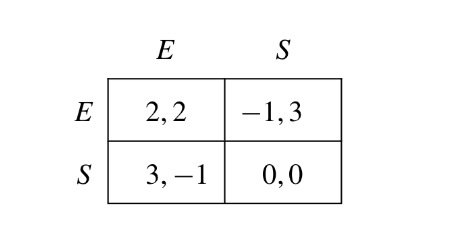
It is claimed in a lemma, when the discount factor lies is neither too high nor too low, there is an equilibrium path which otherwise can't be obtained.

The reason why $(SE, EE^{\infty})$ constitutes an equilibrium totally eludes me. The proof is as follows

Question: I don't understand why the first inequality relates to $\frac{1-\delta}{\delta}$, since it's a lower bound to induce effort, while in the mentioned inequality, the right hand side is about payoff of shirking in current period.


The first part of the proof of this lemma is just trying to show that there is no equilibrium in which any player plays $E$ today and their opponent plays $S$ in the following period. (This intermediate result will imply that if any player plays $E$ today, their opponent must play E in the following period.) As you should know from having made it this far in the book (Proposition 2.5.1), any equilibrium payoff pair today has to be supported by continuation values for the players that are themselves equilibrium payoffs. (This is what it means for equilibrium payoffs to be self-generating.)
So what Mailath and Samuelson are showing in the first paragraph of their proof of Lemma 2.5.1 is that a strategy in which a play of E today is followed by the opponent playing S tomorrow cannot be part of an equilibrium. In particular, if player 2 plays E today, he gets some continuation value, which we can call $γ₂^{t+1}$. This continuation value has to satisfy two conditions. First, $γ₂^{t+1}$ has to be big enough so that player 2 actually wants to play E today (which is necessary for it to be part of an equilibrium). That is, it has to be the case that $γ₂^{t+1}≥(1-δ)/δ$, which is the inequality given from (2.5.2).
Second, $γ₂^{t+1}$ has to actually be equal to the payoffs that player 2 will receive. That is, it has to be equal to $(1-δ)$ times whatever player 2 will get in period $t+1$ plus $δ$ times whatever player 2's continuation value will be in the game that follows period $t+1$. Under the proposed strategy, this implies that
$$γ₂^{t+1}=(1-δ)u₂(Sa₂^{t+1})+δγ₂^{t+2}.$$
Next, we know that if 1 is playing $S$ in period $t+1$, then player 2 is either getting $0$ or $-1$. Either way, he's getting something less than $0$. Next, we know that when $δ≥1/3$, the highest possible equilibrium payoff player 2 could hope to get from period $t+2$ on is $8/3$. This is what he would get if the players played $(SE,EE^{∞})$, in which case he would get $$(1-δ)⋅3+δ⋅2=3-δ≥3-1/3=8/3.$$ It still remains to show that this is indeed the highest possible equilibrium payoff, which is the last paragraph of the proof. As a result, since $u₂(Sa₂^{t+1})≤0$ and $γ₂^{t+2}≤8/3$, it follows that this second requirement implies that
$$γ₂^{t+1}≤8δ/3.$$
And therefore $γ₂^{t+1}$ has to satisfy both $γ₂^{t+1}≥(1-δ)/δ$ and $γ₂^{t+1}≤8δ/3$, which is only possible for $δ>0.45$. And therefore it has to be the case that if any player plays $E$ today, his opponent plays $E$ tomorrow.
I'd like to also add that the title of this question is not quite what this lemma in Mailath and Samuelson is about. The intention of this lemma is to provide an example in which (without public randomization devices that convexify the set of equilibrium payoffs in a repeated game) the set of equilibrium payoffs is not always increasing (in set order) in the discount factor.