Informally, I have heard for a function to be considered as a fractal - the function can never be "smooth". This means that if you keep "zooming in", you will never have a "smooth" section. Smoothness is an important property for derivatives - if a function is never smooth, this means that you can not take it's derivative (I have always accepted this fact as a "intuitive" fact, but I have never understood the pure mathematical logic behind why a function needs to be smooth in order for it to be differentiable).
But is there a mathematical definition that can be used to decide whether a given function can be considered as a "Fractal" or "Not a Fractal"?
I tried looking for such a mathematical function, but the closest thing I could find was the following link (https://en.wikipedia.org/wiki/Fractal):
According to Falconer, fractals should be only generally characterized by a gestalt of the following features:
- Self-similarity, which may include:
- Exact self-similarity: identical at all scales, such as the Koch snowflake
- Quasi self-similarity: approximates the same pattern at different scales; may contain small copies of the entire fractal in distorted and degenerate forms; e.g., the Mandelbrot set's satellites are approximations of the entire set, but not exact copies.
- Statistical self-similarity: repeats a pattern stochastically so numerical or statistical measures are preserved across scales; e.g., randomly generated fractals like the well-known example of the coastline of Britain for which one would not expect to find a segment scaled and repeated as neatly as the repeated unit that defines fractals like the Koch snowflake.
-Qualitative self-similarity
- Multifractal scaling: characterized by more than one fractal dimension or scaling rule
- Fine or detailed structure at arbitrarily small scales. A consequence of this structure is fractals may have emergent properties. -Irregularity locally and globally that cannot easily be described in the language of traditional Euclidean geometry other than as the limit of a recursively defined sequence of stages.
For example, an example of a famous Fractal as well as one of the earliest defined Fractals is the Weierstrass Function (https://en.wikipedia.org/wiki/Weierstrass_function) :

https://download.ericduminil.com/weierstrass_zoom.gif
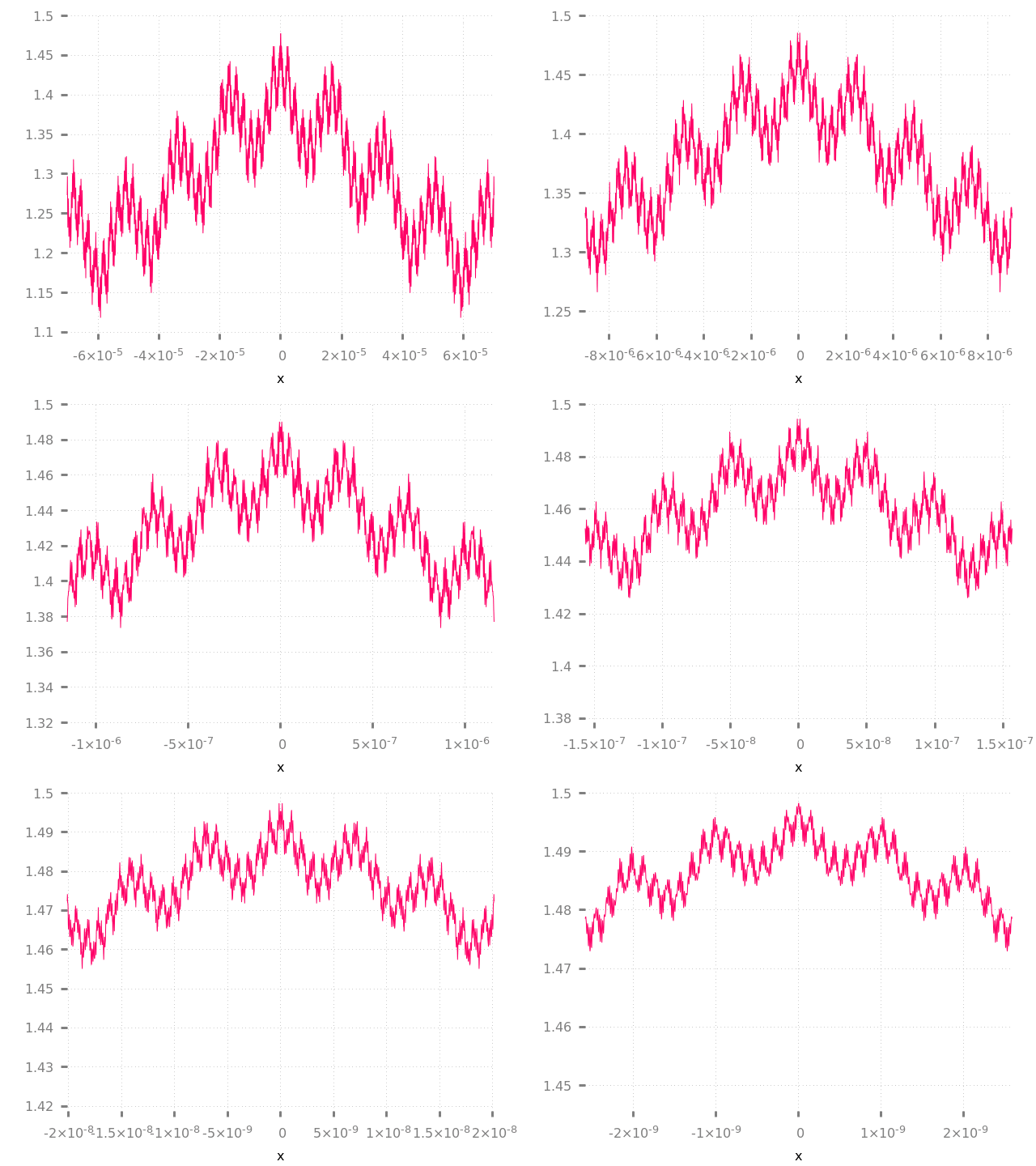
I have heard that the Weierstrass Function is non-differentiable - this is because even though the Weierstrass Function itself converges, it can be shown that the derivative of the Weierstrass Function at any point is "infinity" (i.e. does not converge) : this effectively means that the Weierstrass Function does not have a derivative.
We say that a function that is a fractal is non-differentiable - but how exactly do we know if a function can be considered as a "fractal" or "not a fractal"? As a facetious question - why are y = x^2 and y = sin(x) not considered as "fractals", but the Weierstrass Function is considered as a "fractal"?
Thanks!
Note: It seems to me that the Weierstrass Function is non-differentiable primarily because of the mathematical proof involving its derivatives not-converging - and less to do with it being considered as a fractal? Or does these properties go hand-in-hand?
References: