Problem: $2$ blue, $2$ red, $2$ white balls are arranged around a circle randomly. What is the probability that the same color balls will always neighboring?
1. I did'n find correct last word for the problem: '...always neighboring? ...always together? ...always side by side?' I hope that the problem statement clearly.
2. I have some solutions of the problem. I think that first solution is correct. But I'm not sure, Which is correct?
Solution 1: There is no identical object in the probability. By circular permutation, number of elements of sample space is $(6-1)!=5!=120 $. Number of elements of the given event is $(3-1)!\cdot 2\cdot 2 \cdot 2 = 16$ Hence, probability of given event $$ p= \dfrac{16}{120} = \dfrac{2}{15} $$
Alternatively Solution 2: There is no identical object and there is no identical location in the probability. That is, we can't use circular permutation and identical objects. So, number of elements of sample space is $6!=720$. Number of the given event is $3!\cdot 2\cdot 2 \cdot 2 = 48$. Probability of given event $$ p= \dfrac{48}{720} = \dfrac{1}{15} $$
Alternatively Solution 3: We have to take identical object same color balls. Easily, we can calculate number of elements of sample space that $16$. Also, Number of elements of the given event is $2$. Therefore, probability of given event $$ p= \dfrac{2}{16} = \dfrac{1}{8} $$
$16$ elements of the sample space for identical objects:
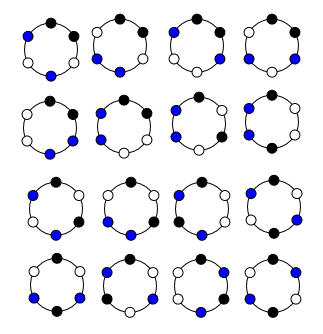
Thanks for your interest.

Added later: Your edit to the question with a diagram has raised an issue about the first part of my earlier response
I initially agreed with your first result, saying:
As your diagram shows, there are in fact $16$ possible patterns after taking account of rotations and double colours rather than $15$. To complicate matters, these $16$ are not equally likely and that is the problem with your third alternative.
Most of the patterns can occur $6 \times 2^3=48$ different ways. But two of them cannot, namely those where opposite balls are the same colour (the final patterns in your third and fourth rows); because they are rotationally symmetric to themselves through half a circle, they can only occur $24$ different ways and so should only have half a weight in the calculation. That would make the probability $\dfrac{2 \times 1}{14\times 1 + 2 \times \frac12}= \dfrac2{15}$
Your second alternative is missing half the possibilities. If all the balls can be individually identified and all the positions can be identified then I would have thought the numerator would counting choices clockwise from a given position be $6 \times 1 \times 4 \times 1 \times 2 \times 1 + 6 \times 4 \times 1 \times 2 \times 1 \times 1 = 96$.
The denominator is then $6!=720$ and so the result is $\dfrac{96}{720}=\dfrac{2}{15}$ again