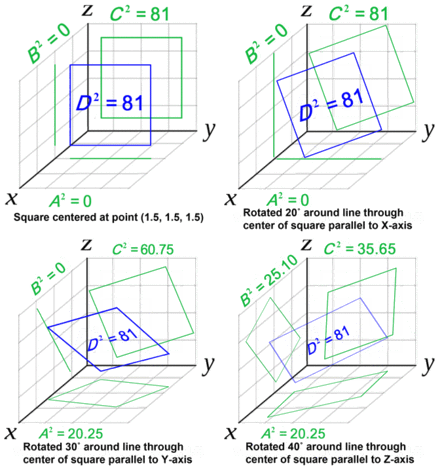
In Terry Tao's blog on determinantal processes, he mentions that:
From this and the ordinary Pythagorean theorem in the inner product space ${\bigwedge^n {\mathbb R}^N}$, we conclude the multidimensional Pythagorean theorem: the square of the ${n}$-dimensional volume of a parallelopiped in ${{\mathbb R}^N}$ is the sum of squares of the ${n}$-dimensional volumes of the projection of that parallelopiped to each of the ${\binom{N}{n}}$ coordinate subspaces ${\hbox{span}(e_{i_1},\ldots,e_{i_n})}$.
I get this more or less. That if $\{e_1, e_2, e_3\}$ are a basis of $\mathbb{R}^3$ then $\{e_1 \wedge e_2, e_2 \wedge e_3, e_3 \wedge e_1\}$ are a basis of $$ \mathbb{R}^3 \wedge \mathbb{R}^3 \simeq \mathbb{R}^3$$
Then we can compute lengths of lines this way that much is easy (or well-understood): $$ \big|\big| a e_1 + b e_2 + c e_3 \big|\big|^2 = \sqrt{a^2 + b^2 + c^2}$$ I am having a much harder time visualizing the wedge product version of this: $$ \big|\big| a (e_1 \wedge e_2) + b (e_2 \wedge e_3) + c (e_3 \wedge e_1) \big|\big|^2 = \sqrt{a^2 + b^2 + c^2}$$ It also wasn't discovered until the 20th century. Here is an image from Wikipedia: