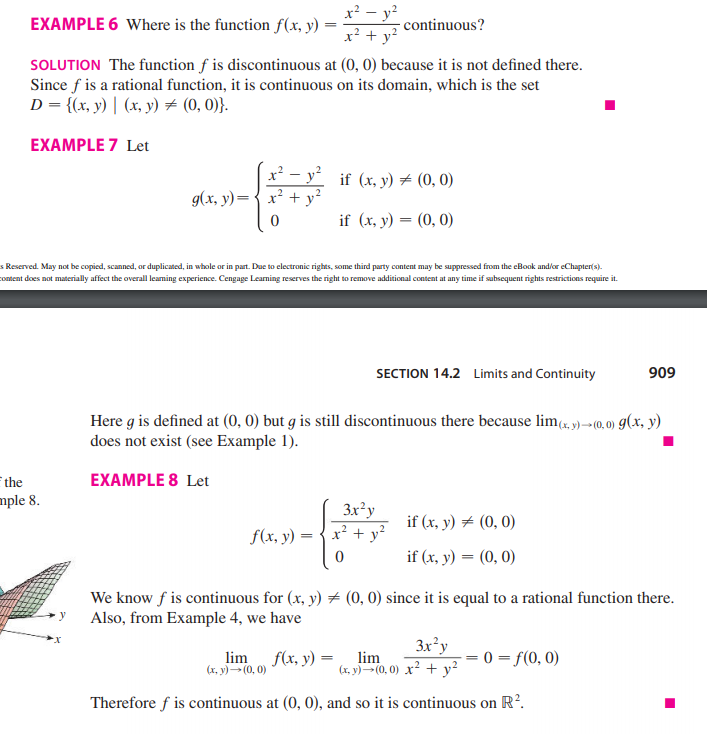
I included example 6 as a context for examples building up but the main concern with my question is examples 7 and 8 from Stewart's Calculus, the 8th edition.
Example 7's rationale is that although with the piecewise representation, the function $g(x,y)$ is defined at $(0,0)$, it is still discontinuous because the limit at that point which approaches $(0/0)$ does not exist.
However, in example 8, a function of similar nature is shown. Yet again the function $f(x,y)$ is defined explicitly at point $(0,0)$ by the piecewise representation. Yet this time the author goes to take the limit of the function and arrives at the conclusion that the $limit$ of $(f,x)$ as $(x,y)$ approaches $(0,0)$ is $0$ and defined.
Don't have high enough reputation so link to image is here: https://i.gyazo.com/87f2e2e625c5f2cc25cdb041f8015eba.png)
I don't understand how this is logical? I see that the $limit$ for $(x,y)$ would result in yet another $0/0$ fraction which would mean it is discontinuous because that limit does not exist. Can anyone care to explain?

Not a full answer but I wanted to show you this image to show why $f$ is continuous and $g$ is not:
Here $g(x,y)$ is the larger red curve and $f(x,y)$ is the lower blue curve. For this image, $y=0.1$
As you see, $f$ is continuous meanwhile $g$ has a discontinuity at $x=0$. As $x$ approaches $0$, $g$ approaches $-1$, however $g(0,0)=0$.