I was wondering what the plot of an $N(\mu, +\infty)$ density look like.
Per my understanding, a variance of zero means a horitonzal line (i.e. constant density). As variance increases, so does the slope of the peak you see on the graph.
If we take this reasoning to the limit, my conjecture is that the graph of a Gaussian variable with infinite variance would be the x-axis, except for a single point where the value of the function is strictly positive.
Is this correct? If so, what would that point be and what would the value of the function be in that point? My guess would be that it doesn't really matter, as far as the density being integrable into a cumulative distribution function, as the definite integral of a single-point interval is $0$ no matter the value of the function in that point.

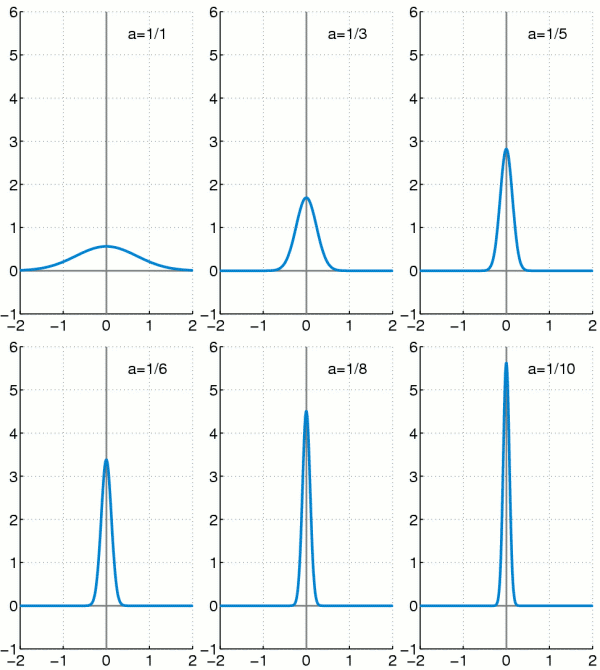
You have it the wrong way round. $N(\mu,\infty)$ would be "infinitely spread out", the $x$-axis with no spikes, a distribution where every real number has the same chance of appearing – which is impossible.
What you have in mind is the limit $N(\mu,0)$. It is not a function in the usual sense, but it is still a distribution. It is the Dirac delta dunction $\delta(\mu)$.
The Wikipedia page on it has this cute little graphic showing how the normal distribution becomes $\delta$ in the zero-variance limit: