Wikipedia's section on rigid shapes does not appear to actually define what a rigid shape is. Rather it defines 'same shape' and 'rigid transformations' without giving any definitions of what is necessary and sufficient for a shape to be considered rigid.
For instance, I've seen the following image:
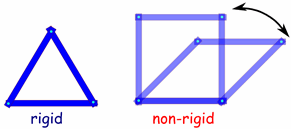
I understand intuitively why the triangle is rigid and quadrilateral is non-rigid. It is also my understanding that inserting a single diagonal connection into the quadrilateral would make the shape rigid? However, given the following image (labeling the shapes $S_1$, $S_2$ and $S_3$ in sequence left to right):

If $S_1$ had a single diagonal connection AB, it would be possible to flip ADB over axis q to obtain a shape similar to $S_2$ with the addition of connection AB (my explanation may not be the greatest). This shape is clearly not the same as $S_1$, so how can we say $S_1$ with a single diagonal connection CD is rigid? I feel I am unclear on what the definition of rigidity actually is.

The reason you are finding these ideas hard to reconcile is because the diagram is referring to a physical notion of rigidity, while the wiki page you're reading is centered around a geometrical notion of rigidity. (I don't find the article you linked to be particularly clearly written either.)
Geometry
In geometry, we don't talk about rigid shapes really, we talk about rigid transformations. Shapes in geometry are just sets of points, not physical objects with resistance to bending and stretching. They are at the mercy of transformations applied to them.
Assuming we are working in a geometry that has notions of how to measure angles and distances:
The idea is that no matter what shape we start out with, any shape you draw in the plane at all will look the same after a rigid transformation is applied, except that its location and situation might be different from what it used to be. (It might also be its mirror image, if you have allowed transformations to flip the orientation of the plane.)
Many of those shapes would be changed if we picked a nonrigid transformation, for example, the transformation given by $x\mapsto x$ and $y\mapsto 2y$ in the Cartesian plane. This would change a circle at the origin into an ellipse.
If you are interested in geometry that is not founded upon distance, then you can adopt some geometry axioms that assume notions of congruence of segments and angles. Rigid transformations of the plane would then be ones which do not disturb segment congruence nor angle congruence.
Physics
Now, there is a notion of rigidity in reality that has more to do with its resistance to changing shape. This is called structural rigidity. This is really not the same animal as rigidity of shape in geometry, although it's obviously related.
In the diagram you supplied, the point seems to be that we are assuming the segments do not change length, but that the joints are on hinges. You are able to apply physical forces to both, and see how they behave. One would classify the triangle as a rigid shape because none of its edgelengths or angles would change because of the intrinsic shape of the object. The square on the other hand isn't geometrically limited to having 90 degree angles when you apply pressure to it, so it can change into a rhombus rather quickly.
Moreover, you could easily imagine building an object with length changing segments and rigid hinges, so that a square could be pulled into a rectangle, but not pushed over into a rhombus. I don't think that object would be considered "rigid" either.
Conclusion
Hopefully I've expressed a bit about the difference between these two studies.
I don't mean to say that the physics notion is totally disjoint from mathematics: for sure physical rigidity can be analyzed with mathematics. It's just that the wiki page on geometry was not where you wanted be if you're interested in structural rigidity.