Consider an ellipse and a circle inside it. They have the same center. Let $P$ be a moving point on the ellipse. Through $P$, draw the two tangents to the circle, which meet the ellipse at $A,B$. Again, through $A,B$ respectively, draw the tangents to the circle, which meets each other at $Q$. What's the locus of $Q$?
By software graphing, it seems to be an ellipse too. But how to prove this without much computation? It's better to explain by projective geometry.


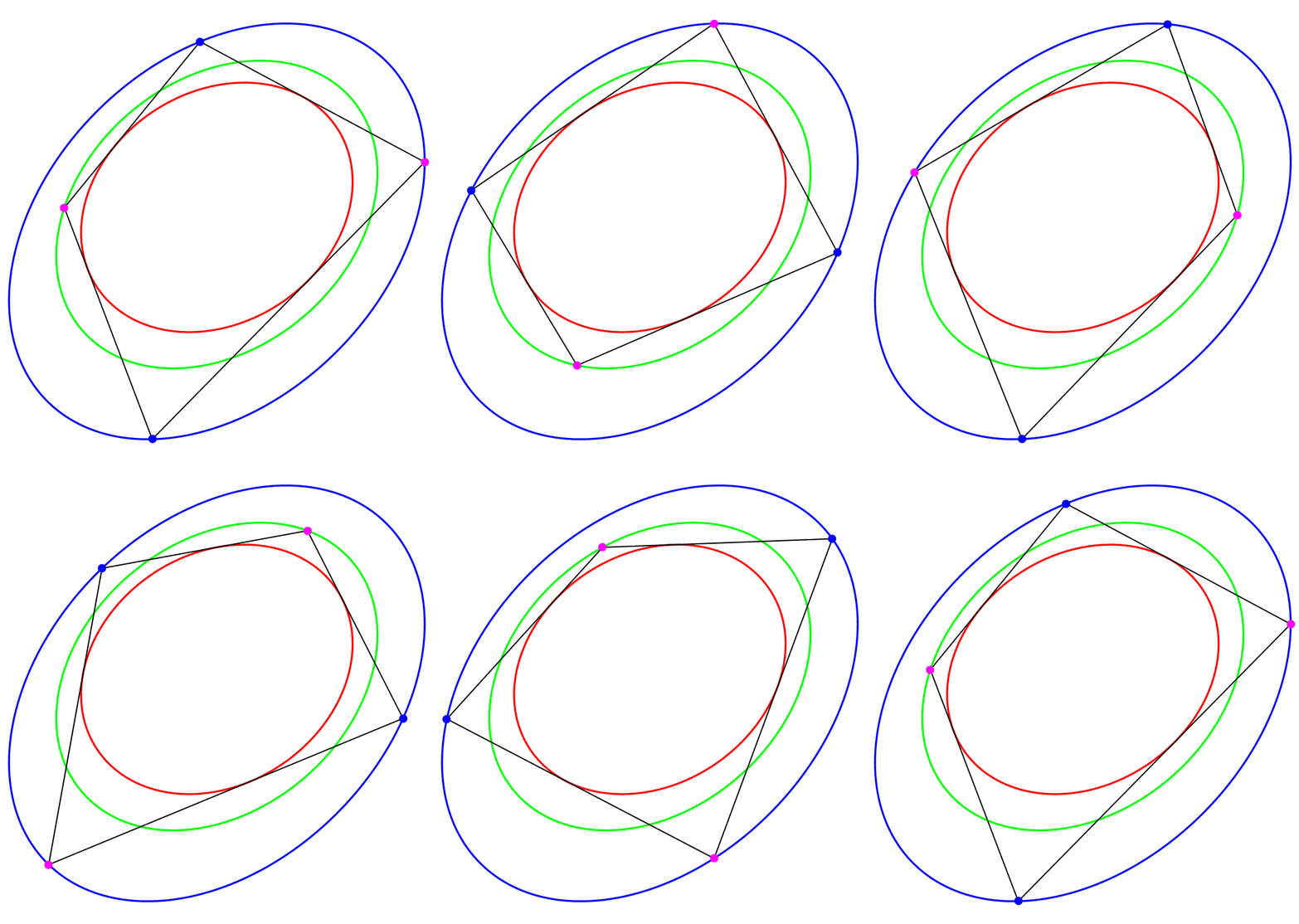
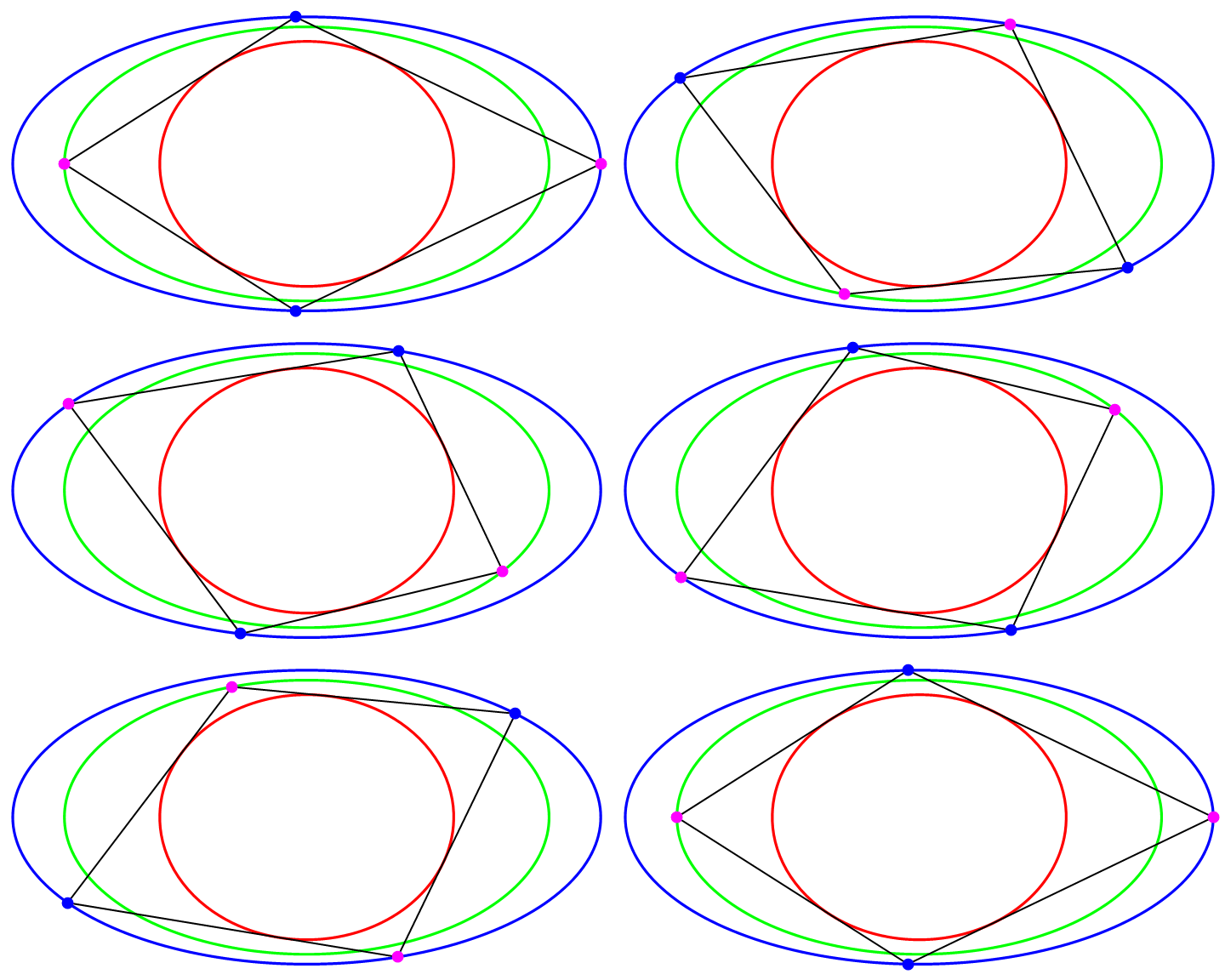


This is an algebraic proof using complex numbers. It is not simple but not that horrible. One corollary of this proof is coordinates of $P$ and $Q$ are related by different scaling in $x$- and $y$- direction $(*2')$. I think this could be a key for any geometric proof of this interesting problem.
Choose a coordinate system so that the circle/ellipse are centered at origin, the circle has unit radius and the semi-major axis of the ellipse is the $x$- axis. Let $\alpha, \beta$ be the semi-major and semi-minor axes of the ellipse. We will assume $\alpha > \beta > 1$ so that the ellipse lies completely outside the circle.
Identify points with complex numbers. We will use upper case letter to denote a point and same lower case letter to denote corresponding complex number.
Let $Z = (x,y)$ be any point outside the unit circle. $z = x + iy$ and $Z$ lies on the ellipse when and only when $$\begin{align}\frac{x^2}{\alpha^2} + \frac{y^2}{\beta^2} = 1 &\iff \frac{(z + \bar{z})^2}{\alpha^2} - \frac{(z - \bar{z})^2}{\beta^2} = 4\\ &\iff \lambda(z^2 + \bar{z}^2) + 2(1-\mu)z\bar{z} = 4\end{align}\tag{*1}$$ where $\displaystyle\;\lambda = \frac{1}{\alpha^2} - \frac{1}{\beta^2}$ and $\displaystyle\;\mu = 1 -\frac{1}{\alpha^2} - \frac{1}{\beta^2}$.
It is not hard to show under inversion with respect to the unit circle, point $Z$ get mapped to midpoint of $U$ and $V$. In terms of corresponding complex numbers, we have
$$\frac{1}{\bar{z}} = \frac{u+v}{2} \implies \bar{z} = \frac{2}{u+v} \implies z = \frac{2uv}{u+v}$$
Substitute this into ($*1$) and simplify, the condition for $Z$ to lie on the ellipse becomes $\Omega(u,v) = 0$ where $$\begin{align} \Omega(u,v) &= \lambda( \lambda(1 + u^2 v^2 ) + 2(1-\mu)uv - (u+v)^2)\\ &= \lambda( (\lambda u^2 - 1)v^2 - 2\mu uv + (\lambda - u^2))\\ &= (\lambda u^2 - 1)(\lambda v^2 -1 ) - (1 - \lambda^2 + 2\lambda\mu uv) \end{align}$$
Let $E, F, G, H$ be the points on unit circle touching the line segments $QA, AP, PB$ and $BQ$ respectively. Since $A, P, B$ lies on the ellipse, we get
$$\Omega(e,f) = \Omega(f,g) = \Omega(g,h) = 0$$ Notice $\Omega(u,v)$ is symmetric in $u,v$ and is a quadratic polynomial in of its arguments. $e$ and $g$ and roots of the quadratic polynomial $\Omega(f,\cdot)$, By Vieta's formula, we get
$$e + g = \frac{2\mu f}{\lambda f^2 - 1} = \frac{2\mu f(\lambda g^2 - 1)}{1 - \lambda^2 + 2\lambda \mu f g}$$ By a similar argument to $f, h$ and $\Omega(g,\cdot)$, we have
$$f + h = \frac{2\mu g}{\lambda g^2 - 1} = \frac{2\mu g(\lambda f^2-1)}{1 - \lambda^2 + 2\lambda \mu f g}$$ Summing these and rearrange, we find
$$e + h = \left[\frac{2\mu( \lambda fg - 1)}{1 - \lambda^2 + 2\lambda \mu f g} - 1\right](f+g) = - \frac{1- \lambda^2 + 2\mu}{1 - \lambda^2 + 2\lambda \mu f g} (f + g)$$
Taking complex conjugate, invert them and using $fg = \frac{p}{\bar{p}}$, we get $$q = - \frac{1 - \lambda^2 + 2\lambda\mu \bar{f}\bar{g}}{1 - \lambda^2 + 2\mu} p = - \frac{(1-\lambda^2) p + 2\lambda \mu \bar{p}}{1 - \lambda^2 + 2\mu}\tag{*2}$$ If $P = (x_p,y_p)$ and $Q = (x_q,y_q)$, this is equivalent to
$$(x_q, y_q) = \left( -\frac{1 - \lambda^2 + 2\lambda \mu}{1 - \lambda^2 + 2\mu} x_p, -\frac{1 - \lambda^2 - 2\lambda\mu}{1 - \lambda^2 + 2\mu} y_p\right)\tag{*2'}$$
As long as $1 - \lambda^2 + 2\mu \ne 0$, $Q$ lies on the ellipse $\displaystyle\;\frac{x_q^2}{\tilde{\alpha}^2} + \frac{y_q^2}{\tilde{\beta}^2} = 1$ where
$$( \tilde{\alpha}, \tilde{\beta} ) = \left( \alpha \left|\frac{1 - \lambda^2 + 2\lambda \mu}{1 - \lambda^2 + 2\mu}\right|,\; \beta \left|\frac{1 - \lambda^2 - 2\lambda \mu}{1 - \lambda^2 + 2\mu}\right|\right)$$