What I understand so far:
This shape has 12 triangular faces (all equilateral triangles since this is a Johnson solid) and 8 vertices. We have 4 faces meeting at 4 of the vertices and 5 faces meeting at the other 4 vertices.
The two vertices where 4 faces meet can be split into 2 groups, each group containing 2 such vertices that are connected between them and not connected to any of the 2 vertices in the other group. This means we can get this shape by taking two regular octahedra, removing 2 adjacent faces from each and then joining them.
We could also build it starting from a pentagonal bipyramid as shown here.
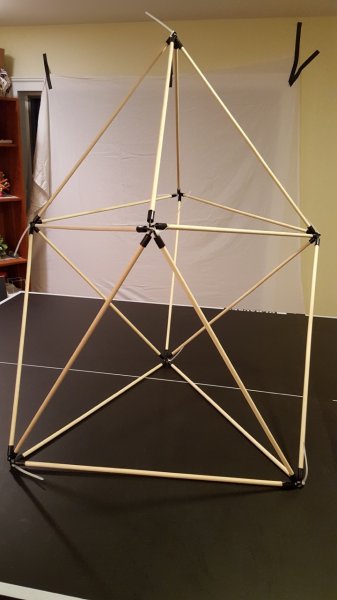
What can be seen in the above figure is that at each vertex where 5 faces meet, we have 2 groups of 2 faces that are almost in the same plane.
What I want to know
How can I compute the angles of the faces?
I want to get these angles without starting from the vertex coordinates which I can find online because that's just starting from the solution.

It is instructive to work out the vertex coordinates from first principles, then compute dihedral angles from these.
Orient the polyhedron so that the two reflection planes of symmetry coincide with the $xz$- and $yz$-planes; that is to say, the twofold rotational axis of symmetry is the $z$-axis. Consequently, without loss of generality, for a unit edge length, the vertices are of the form $$(\pm a, 0, -b), \quad (\pm 1/2, 0, c), \quad (0, \pm a, b), \quad (0, \pm 1/2, -c)$$ for $a, b, c > 0$. This gives rise to the system of equations $$\begin{align*} \left(a-\frac{1}{2}\right)^2 + (b+c)^2 &= 1, \\ a^2 + \frac{1}{4} + (b-c)^2 &= 1, \\ 2a^2 + 4b^2 &= 1. \end{align*}$$ The unique nontrivial positive solution to this system results in roots of a cubic; specifically, $a$ satisfies $$2 - 2 a - 3 a^2 + 2 a^3 = 0$$ and $$b = \frac{1}{2} \sqrt{1 - 2a^2}, \quad c = \sqrt{\frac{1 + a - a^2}{2}}.$$ The numeric values are approximately $$\begin{align*} a &\approx 0.64458427322415498454 \\ b &\approx 0.20556156585325953808 \\ c &\approx 0.78393092423256364992. \end{align*}$$ The computation of the dihedral angles is tedious but straightforward. These are, in radians, approximately $$1.6789775749362604980, 2.1248189366147042378, 2.9049356464412552144.$$