Why does the result of cutting a Möbius strip down the middle lengthwise have two full twists in it? I can account for one full twist--the identification of the top left corner with the bottom right is a half twist; similarly, the top right corner and bottom left identification contributes another half twist. But where does the second full twist come from?
Explanations with examples or analogies drawn from real life much appreciated.
edit: I'm pasting J.M.'s Mathematica code here (see his answer), modified for version 5.2.
twist[{f_, g_}, a_, b_, u_] := {Cos[u] (a + f Cos[b u] - g Sin[b u]),
      Sin[u] (a + f Cos[b u] - g Sin[b u]), g Cos[b u] + f Sin[b u]};

With[{a = 3, b = 1/2, f = 1/2},
Block[{$DisplayFunction = Identity},
g1 = ParametricPlot3D[Evaluate[Append[twist[{f - v, 0}, a, b, u],
  {EdgeForm[], FaceForm[SurfaceColor[Red], SurfaceColor[Blue]]}]],
  {u, 0, 2 Pi}, {v, 0, 2 f}, Axes -> None, Boxed -> False];
g2 = ParametricPlot3D[Evaluate[Append[twist[{f - v, 0}, a, b, u],
  EdgeForm[]]], {u, 0, 4 Pi}, {v, 0, 2 f/3},
  Axes -> None, Boxed -> False];
g3 = ParametricPlot3D[Evaluate[Append[twist[{f - v, 0}, a, b, u],
  {EdgeForm[], FaceForm[SurfaceColor[Red], SurfaceColor[Blue]]}]],
  {u, 0, 2 Pi}, {v, 2 f/3, 4 f/3}, Axes -> None, Boxed -> False,
 PlotPoints -> 105]];
GraphicsArray[{{g1, Show[g2, g3]}}]];

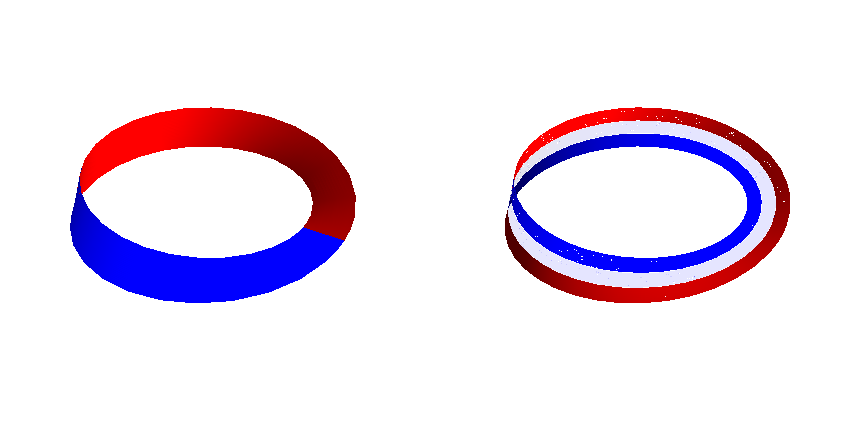
One twist comes from the two half-twists of the Möbius strip. Another comes from the fact that just after you've made the cut, the resulting half-width strip goes two times around the cut, so it will turn an extra time when you unfold it to a large circle.
Try making an ordinary strip that goes two times around a cylinder and then meets itself, without a Möbius twist. If you remove the cylinder and try to unfold your strip to a circle, it will have one full twist. This twist arises from the fact that the strip's centerline must wind around itself when it goes around the cylinder twice. (In the cut-Möbius case, the direction of this winding depends on the direction the original Möbius strip was twisted, which means that the single twist from the unfolding adds to the two half-twists rather than cancel them out).
Another everyday effect that shows this (in reverse) is to try to wrap a rubber band (an ordinary cylindrical-section rubber band with a flat cross section) twice round a package. It will need to twist in order to do this, even if it can lie flat wrapped once around the package.